

What is DCA investing? Dollar-Cost Averaging (DCA) is an investment strategy in which a fixed amount of capital is invested at regular intervals, regardless of prevailing market conditions. Rather than concentrating exposure at a single point in time, DCA distributes investment entry across multiple market cycles.
By allocating capital systematically, DCA reduces the influence of short-term price fluctuations on the overall purchase cost. When asset prices decline, the same contribution acquires more units, while higher prices result in fewer units purchased. Over time, this process produces an averaged cost basis that reflects a range of market conditions rather than a single valuation point.
Beyond its mechanical structure, dollar-cost averaging plays an important role in investor behavior by limiting emotional decision-making and replacing discretionary timing choices with a predefined investment schedule.
For this reason, DCA is widely used in long-term investment frameworks, including retirement portfolios, index fund strategies, and automated investment plans, where consistency and discipline support sustained wealth accumulation.
Key Takeaways
- Dollar-cost averaging: Involves investing a fixed amount at regular intervals, independent of short-term market movements
- Volatility management: Reduces the impact of price fluctuations by spreading investment entry across multiple market conditions
- Behavioral discipline: Encourages long-term consistency by limiting emotional investment decisions
- Common applications: Used in retirement investing, index fund strategies, and automated investment plans
What Is Dollar-Cost Averaging (DCA)?
Dollar-Cost Averaging (DCA) investing is an investment strategy where you invest a fixed amount of money at regular intervals, regardless of the financial asset’s price. This systematic approach, often referred to as systematic investing or using a systematic investment plan, means you buy more shares when share prices are low (during a market dip or even a bear market) and fewer shares when share prices are high (during bull markets). Over time, this results in a lower average cost per share compared to investing a lump sum at a single, potentially high, market point.
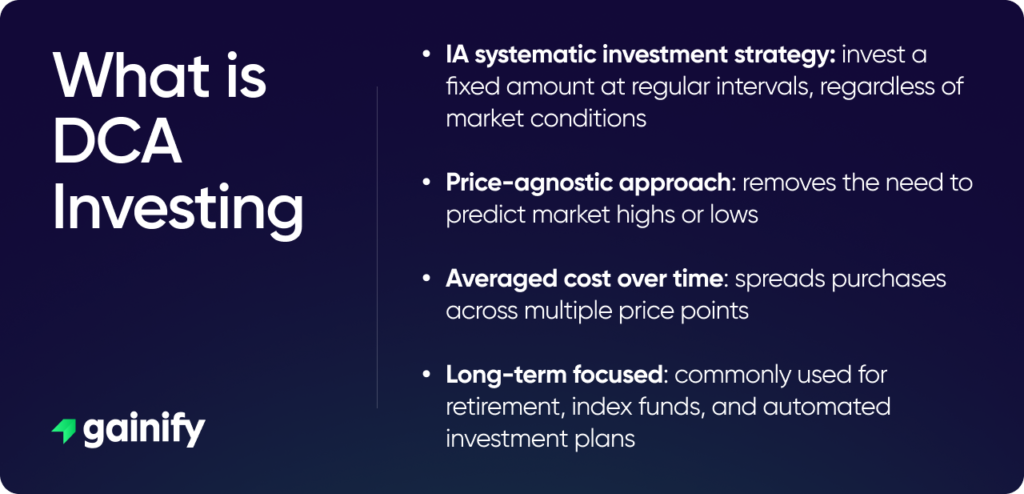
The core principle behind DCA is to reduce the impact of market volatility on your overall investment. Instead of attempting the difficult feat of market timing, which involves predicting market highs and lows, DCA encourages a disciplined, consistent approach. This removes emotional biases, like the anchoring bias studied by behavioral economists, from your decision-making, as you commit to a regular investment plan and schedule automatic contributions or automatic investment.
How Dollar-Cost Averaging Works
Dollar-cost averaging works by spreading investment purchases over time through regular, fixed contributions. Instead of investing a lump sum at once, an investor commits the same dollar amount at each interval, regardless of whether prices are rising or falling.
Each contribution buys a variable number of units based on the current market price. When prices are lower, the fixed amount purchases more units. When prices are higher, it purchases fewer units. Over multiple investment periods, this process results in an average cost per unit that reflects a range of market conditions rather than a single entry point.
DCA is typically implemented through automatic investment plans, such as recurring contributions to a brokerage account, retirement plan, or investment platform. Automation ensures consistency and reduces the influence of short-term market movements on investment decisions.
Example of Dollar-Cost Averaging
Assume an investor contributes $500 per month to an index fund over four months:
Month | Investment Amount | Price per Unit | Units Purchased |
|---|---|---|---|
Month 1 | $500 | $50 | 10.0 |
Month 2 | $500 | $40 | 12.5 |
Month 3 | $500 | $60 | 8.33 |
Month 4 | $500 | $45 | 11.11 |
Over four months, the investor invests $2,000 and acquires approximately 41.94 units. The average cost per unit is $47.69, which reflects the range of prices paid rather than any single market level.
By maintaining consistent contributions across different price points, dollar-cost averaging helps smooth the investment entry process and reduces reliance on market timing.
Advantages of Dollar-Cost Averaging
Dollar-Cost Averaging (DCA) offers several practical advantages for investors who prioritize consistency, discipline, and long-term participation in financial markets.
- Minimizing Market Timing Risk: You avoid the pressure of trying to predict when the market will rise or fall, a task even professional fund managers struggle with consistently. This helps to overcome investor psychology pitfalls.
- Encouraging Discipline: By automating your investments, often through your brokerage account or 401(k) plans, DCA fosters a consistent savings habit. This systematic approach removes emotional decision-making often associated with market volatility. This is sometimes called automating purchases or setting up a Repeat Buy.
- Lowering Average Cost: By purchasing more units when prices are low and fewer when prices are high, your average cost per share typically becomes more favorable over the long term. This contrasts with a single, lump-sum investment.
- Accessibility: DCA makes investing approachable for individuals with limited capital, allowing them to start with smaller, regular contributions. It works well for various asset classes, from stocks to bond funds, and even the cryptocurrency market.
- Behavioral Benefits: It helps mitigate common investor pitfalls driven by fear or greed. This is a key finding from behavioral economics, preventing decisions based on market sentiment or chasing hot stocks, which can lead to poor investment results. It also allows compound interest to work its magic over a longer investment horizon.
Dollar-Cost Averaging vs Lump-Sum Investing
Dollar-cost averaging and lump-sum investing represent two different approaches to deploying capital into the market. The choice between them depends on timing, available capital, risk tolerance, and behavioral considerations.
Dollar-cost averaging involves investing a fixed amount at regular intervals over time. This approach spreads market exposure across multiple price levels and reduces sensitivity to short-term market fluctuations.
Lump-sum investing involves investing all available capital at once. This approach maximizes immediate market exposure and allows the full investment amount to benefit from long-term market growth from the outset.
Key Differences
Factor | Dollar-Cost Averaging | Lump-Sum Investing |
|---|---|---|
Investment timing | Gradual over time | Immediate |
Market exposure | Built progressively | Fully deployed upfront |
Volatility impact | Smoothed across periods | Concentrated at entry point |
Behavioral demands | Lower | Higher |
Best suited for | Ongoing income or cautious investors | Large windfalls or high risk tolerance |
Historically, lump-sum investing has tended to outperform in rising markets because capital is invested earlier. However, dollar-cost averaging can be more practical for investors who are contributing from recurring income or who prefer a disciplined, systematic approach that reduces emotional decision-making.
Both strategies can be effective when applied appropriately. The optimal choice depends on an investor’s financial situation, time horizon, and comfort with market volatility.
Who Should Consider Dollar-Cost Averaging?
Dollar-cost averaging is not a one-size-fits-all strategy, but it is well suited to certain types of investors and financial situations.
- New investors: Individuals who are just getting started may benefit from DCA because it reduces the pressure of deciding when to invest and supports gradual market participation
- Recurring income earners: Investors who contribute from regular paychecks can naturally align DCA with monthly or biweekly contributions
- Long-term planners: Those investing for retirement, education, or other long-term goals often use DCA to maintain consistency across market cycles
- Risk-conscious investors: Investors who are uncomfortable with large upfront investments may prefer spreading exposure over time
- Hands-off investors: Those who value automation and minimal ongoing decision-making often find DCA practical and sustainable
Dollar-cost averaging is especially effective when paired with diversified investments and a long investment horizon, where consistency and patience play a central role in long-term outcomes.
When Dollar-Cost Averaging May Not Be Ideal
Dollar-cost averaging is effective in many situations, but it is not always the optimal strategy for every investor or market condition.
- Large lump sums: Investors who receive a windfall, such as an inheritance or bonus, may benefit more from investing sooner rather than spreading investments over time
- Strong long-term market trends: In markets that trend upward over long periods, delaying investment through DCA can result in missed gains
- Short investment horizons: Investors with limited time frames may not fully benefit from the averaging effect
- Low volatility environments: When price fluctuations are minimal, the advantages of spreading purchases over time are reduced
- High cash drag: Holding uninvested cash while gradually deploying capital can lower overall portfolio returns
In these situations, alternative approaches such as lump-sum investing or a hybrid strategy may be more appropriate. As with any investment decision, the suitability of dollar-cost averaging depends on individual circumstances, risk tolerance, and long-term objectives.
What is Not DCA Investing? Common Misconceptions
While DCA investing is a clear and systematic strategy, it is important to understand what it is not. Misconceptions can lead investors away from its core benefits or towards strategies that carry different risks.
- Not Market Timing: DCA is fundamentally opposed to market timing. It does not involve trying to predict the best moment to enter or exit the market, nor does it require constant monitoring of the stock market for perfect entry points. If you are waiting for a specific market dip to invest a large sum, you are attempting market timing, not DCA.
- Not Lump-Sum Investing: If you have a large sum of money available and you invest it all at once, that is lump-sum investing, not DCA. While lump-sum investing has its own merits, especially in historically rising markets, it differs from the periodic, fixed-amount approach of DCA.
- Not Value Averaging: While related, value averaging is a more complex strategy where you adjust your investment amount each period to reach a specific target value for your portfolio. This means the amount you invest varies, unlike the fixed fixed-dollar investments of DCA.
- Not Chasing Hot Stocks: DCA encourages disciplined investment into established funds or diversified portfolios, like index funds or ETFs tracking the S&P 500 or S&P/TSX Composite Index. It is not about buying “hot stocks” based on fleeting market sentiment or investment pitches.
- Not Day Trading or Short-Term Trading: DCA is a long-term strategy. It does not involve frequent buying and selling to profit from minor price fluctuations or daily market movements. It is the antithesis of strategies with high trading costs or designed for short-term gains.
Understanding these distinctions helps ensure your investment plan truly aligns with the benefits of DCA and avoids unintended deviations or risks.
Conclusion
DCA investing offers a straightforward and powerful method for building wealth over the long term. By embracing consistency, minimizing emotional decisions, and leveraging the natural market fluctuations, you can create a strong foundation for your financial future.
Key Takeaways:
- Consistency is Key: Invest a fixed investment amount regularly, regardless of market movements, leveraging automatic contributions or automatic stock purchases.
- Reduce Stress & Risk: Avoid the pressure of market timing and emotional investing, mitigating market risk and the impact of a market crash.
- Lower Average Cost: Benefit from buying more shares when share prices are lower, supporting long-term gains.
- Long-Term Focus: DCA supports a disciplined buy-and-hold strategy for sustained growth across your investment horizon.
- Accessible & Automated: A great strategy for beginners and those with smaller, regular contributions, easily set up through your investment account or 401(k) plans.
- Behavioral Benefits: Helps counter biases noted by behavioral economists, leading to more rational investment results.
Remember, success in investing often comes from disciplined, consistent choices rather than attempting to outsmart complex market conditions or chasing hot stocks and fleeting market trends. As financial advisors and investment professionals consistently emphasize, understanding your risk tolerance and sticking to a well-thought-out financial plan, like DCA, is paramount. This strategy, also known as a systematic investment plan, provides a clear path to achieving your investment objectives. Embrace DCA investing and unlock your potential for enduring prosperity.
Frequently Asked Questions about DCA Investing
What is the core principle of Dollar-Cost Averaging?
The core principle is to invest a fixed investment amount at regular intervals, regardless of the financial asset’s price, to reduce the impact of market volatility and potentially lower your average purchase cost over time. This is a form of systematic investing.
How does DCA investing reduce risk?
DCA reduces the market risk of making a single, poorly timed investment. By spreading out your fixed-dollar investments, you avoid putting all your money into the market at a peak, which can happen with lump-sum investing. This contributes to overall risk management, especially during a bear market or market crash.
Is DCA investing suitable for all types of investors?
DCA is suitable for a wide range of investors, especially those who are new to investing, have a consistent income, or wish to avoid the stress of market timing. It aligns well with long-term investors and long-term investment objectives and can be part of a broader asset allocation strategy. It is applicable in various platforms, from traditional brokerage account offerings.
Can I use DCA for different types of investments?
Yes, DCA can be applied to various asset classes, including individual stocks, index mutual funds, ETFs, and even bond funds. It is a flexible strategy that adapts to your chosen asset mix. It can be integrated with dividend reinvestment plans (DRIPs) or dividend reinvestment programs for compounding growth.
What are the main benefits of avoiding market timing with DCA?
Avoiding market timing with DCA helps prevent emotional decisions driven by fear during market downturns or excessive optimism during rallies. It promotes a disciplined buy-and-hold strategy and reduces the impact of market forecasts. It supports strong investor psychology by removing the temptation to react to every market fluctuation.