


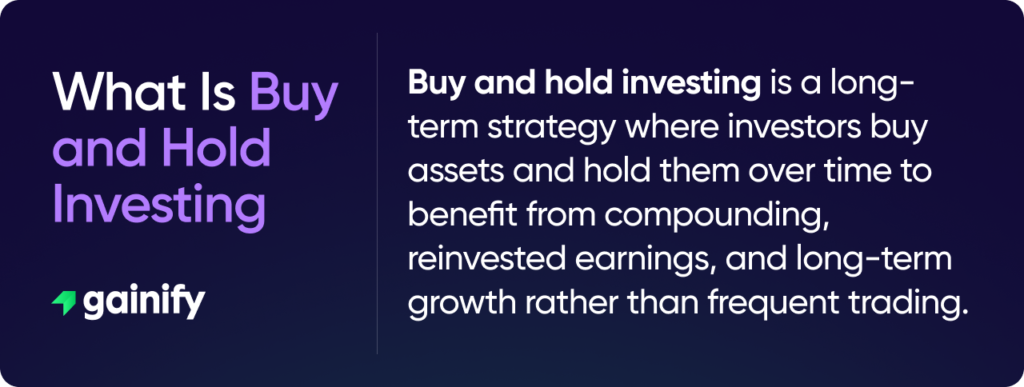
Buy and hold investing is a long-term investment strategy in which an investor purchases assets such as stocks, ETFs, or funds and holds them for many many years, often decades, regardless of short-term market movements.
The objective is to benefit from business growth, reinvested earnings, dividends, and compounding returns rather than attempting to profit from frequent trading or market timing.
The strategy is built on a simple premise: while markets fluctuate constantly, productive assets tend to grow in value over long periods. By remaining invested, buy and hold investors allow time and compounding to outweigh short-term volatility, behavioral mistakes, and transaction costs.
This article explains what buy and hold investing actually means in practice, how it works step by step, why it has endured across multiple market cycles, how intermediate investors can apply it effectively, and where the strategy succeeds or fails in real-world conditions.
Key Takeaways
- Long-term ownership: Buy and hold investing is a long-term ownership strategy focused on maintaining exposure to productive assets across market cycles.
- Compounding effect: Time and reinvestment drive a significant share of total investment returns.
- Low turnover: Fewer trades reduce taxes, transaction costs, and behavior-driven execution errors.
- Built-in volatility: Price fluctuations are expected and incorporated into the investment horizon.
- Behavioral discipline: Consistent decision-making matters more than short-term precision
What Is Buy and Hold Investing in Plain Terms?
At its simplest, buy and hold investing is based on one idea: wealth is built by staying invested, not by constantly trading. Rather than attempting to benefit from short-term price movements, investors remain invested so that business performance, cash generation, and reinvestment can compound over time.
Instead of asking what the market will do next week or next quarter, buy and hold investors focus on questions like:
- Will this business or asset be larger, more profitable, and more valuable in 5 or 10 years?
- Does this investment generate cash flow that can be reinvested?
- Can I hold this asset through recessions, bear markets, and uncertainty?
Buy and hold investing assumes that markets are volatile in the short term but productive over the long term. Prices move erratically, but businesses that create value tend to grow earnings over time. The strategy is designed to capture that growth while minimizing costly mistakes caused by emotion and overreaction.
The Philosophy Behind Buy and Hold Investing
Buy and hold investing is grounded in an understanding of investor behavior rather than assumptions about market perfection. Markets process information continuously, but individual decision-making is often shaped by emotion, short-term incentives, and reaction to noise.
In practice, investors commonly:
- Increase exposure after prices have already risen
- Reduce exposure following market declines
- Pursue recent performance trends
- React to headlines and short-term narratives
These behaviors introduce timing errors that compound negatively over time.
Buy and hold investing reduces the frequency of decisions made under uncertainty. By establishing a long investment horizon, investors shift attention away from short-term price movements and toward underlying asset performance, limiting the influence of emotion-driven actions.
From a structural standpoint, buy and hold investing aligns capital with HOW VALUE IS CREATED in markets. Profitable companies reinvest earnings, expand operations, return capital through dividends, and compound economic value over extended periods. The investor participates in this process by maintaining ownership and allowing those fundamentals to work over time.
How Buy and Hold Investing Works Step by Step
Understanding the mechanics makes it easier to stay committed during volatile periods, because your results are driven by process, not daily price moves.
Step 1: Asset selection and initial allocation. The process starts with allocating capital to productive assets that have a clear economic purpose. This typically means ownership in businesses or funds with sustainable revenue models, reasonable balance sheets, and the ability to generate cash across economic cycles. The focus is not on short-term catalysts, but on whether the asset can remain viable and relevant for many years.
Step 2: Ongoing cash generation. Once invested, the assets begin producing earnings, dividends, or other forms of distributions. These cash flows may seem modest early on, but over time they form a growing portion of total return. For long-term investors, monitoring the stability and growth of cash flow matters more than short-term price changes.
Step 3: Systematic reinvestment. Cash generated by the portfolio is reinvested, either automatically or through periodic allocation decisions. Reinvestment increases ownership without requiring new capital and lowers reliance on future market timing. THIS IS WHERE RETURNS BEGIN TO SCALE, as compounding starts to operate on an expanding base.
Step 4: Extended holding through market cycles. Over longer holding periods, the impact of day-to-day volatility diminishes. Market declines are treated as part of the process rather than as signals to act. As time passes, business performance, earnings growth, and capital allocation decisions increasingly determine outcomes instead of sentiment or headlines.
Step 5: Periodic review across years. At regular intervals, often annually, investors review holdings to confirm that core assumptions still hold. This includes assessing financial health, competitive positioning, and cash-flow sustainability. Adjustments are made only when fundamentals change, not in response to short-term price movements.
Buy and Hold Investing vs Active Trading
The difference between buy and hold investing and active trading is not intelligence or effort. It is where the edge comes from.
Dimension | Buy and Hold Investing | Active Trading |
Primary return driver | Business growth and long-term value creation | Short-term price movements |
Time horizon | Multi-year to multi-decade | Days, weeks, or months |
Decision frequency | Low, deliberate, and infrequent | High and continuous |
Role of timing | Entry timing has limited impact over long horizons | Timing accuracy is central to results |
Core advantage | Compounding over extended holding periods | Speed, execution, and tactical positioning |
Cost structure | Lower transaction costs and tax impact | Higher fees, turnover, and tax friction |
Behavioral demands | Discipline during volatility and drawdowns | Constant focus and emotional control |
Primary risk | Holding assets whose fundamentals deteriorate | Overtrading, mistimed exits, and execution errors |
Active strategies can work for some professionals, but for most investors, costs, taxes, and mistakes compound faster than gains. Buy and hold shifts the advantage away from prediction and toward patience.
Important
Buy and hold does not mean ignoring reality. When fundamentals deteriorate permanently, holding blindly becomes a liability, not a virtue.
4 Core Buy and Hold Investing Strategies Explained
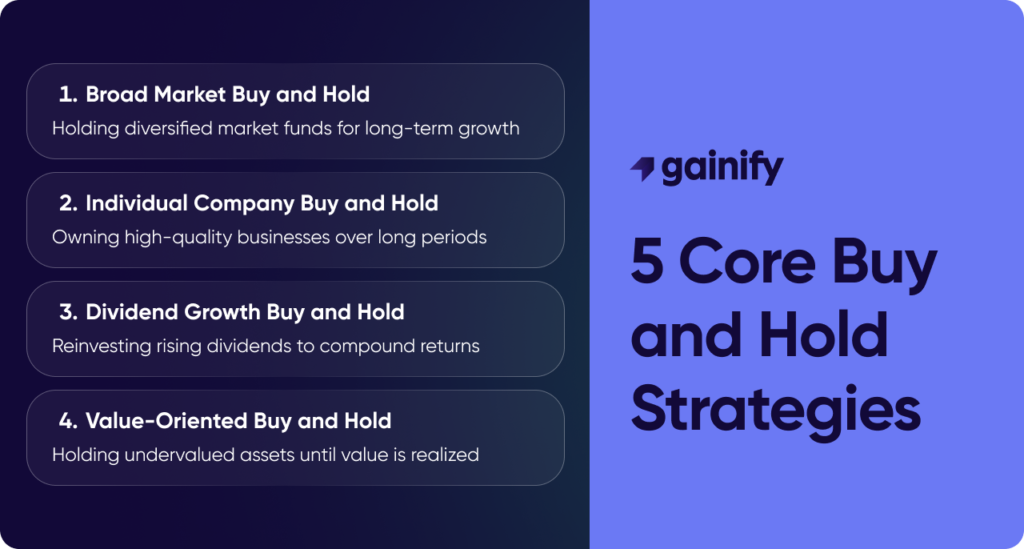
Buy and hold investing operates as a capital allocation framework. Implementation varies based on analytical depth, tolerance for concentration, and the investor’s ability to underwrite long-duration cash flows. The following five strategies represent durable long-term applications, each defined by a distinct return driver and risk profile.
1. Broad Market Buy and Hold Investing
This strategy allocates capital to diversified equity index funds or ETFs that track large segments of the market. Returns are driven by aggregate earnings growth, productivity gains, and reinvestment across the economy.
The strategy depends on:
- Sustained long-term economic expansion
- Broad participation across sectors and industries
- Low implementation and maintenance costs
Its effectiveness comes from capturing market-level compounding while minimizing the need for security-level judgment. Performance is determined primarily by time invested, not tactical decisions.
2. Individual Company Buy and Hold Investing
This approach concentrates capital in selected businesses capable of compounding cash flows at attractive rates over extended periods. The return engine is internal reinvestment efficiency and competitive durability.
Successful execution requires:
- Clear understanding of revenue drivers and cost structure
- Evidence of pricing power or structural advantage
- Ongoing evaluation of balance sheet strength and capital allocation discipline
Returns exceed market averages only when the company continues to deploy capital productively as it scales. Fundamental erosion, not volatility, defines failure.
3. Dividend Growth Buy and Hold Investing
Dividend growth investing focuses on companies that generate consistent free cash flow and return a portion of it to shareholders through steadily rising dividends. Returns are driven by cash distribution growth and reinvestment.
This strategy relies on:
- Stable demand and predictable margins
- Conservative payout ratios
- Management commitment to capital returns
Reinvested dividends increase ownership over time, making total return increasingly dependent on cash generation rather than price appreciation alone.
4. Value-Oriented Buy and Hold Investing
This strategy allocates capital to assets trading below estimated intrinsic value, with the expectation that earnings normalization and balance sheet repair close the valuation gap over time.
The investment thesis rests on:
- Temporary, not structural, impairment
- Sufficient liquidity and solvency to endure downturns
- A credible path to normalized profitability
Time is the key variable. Valuation convergence often occurs unevenly and over extended
Common Mistakes in Buy and Hold Investing
Buy and hold investing breaks down when investors misunderstand what long-term ownership actually requires. The most common issues are not strategic flaws, but execution errors that accumulate over time.
Mistake No. 1: Selling During Market Drawdowns
Market declines are a normal feature of long-term investing. Exiting positions during drawdowns locks in losses and removes capital from the compounding process, often at the point when future returns are improving.
Mistake No. 2: Treating Volatility as Permanent Impairment
Short-term price fluctuations are frequently misinterpreted as lasting damage. Without evidence of fundamental deterioration, volatility alone does not change the long-term value of a productive asset.
Mistake No. 3: Excessive Concentration in a Single Holding
Concentration increases sensitivity to company-specific risks. Even strong businesses can experience unforeseen disruptions, making position sizing and diversification essential to long-term durability.
Mistake No. 4: Holding Assets With Deteriorating Fundamentals
Long holding periods do not eliminate the need for monitoring. Declining balance sheet strength, eroding competitive position, or structural industry shifts warrant reassessment.
Mistake No. 5: Neglecting Risk Management
Ignoring portfolio-level risk can force decisions at inopportune times. Liquidity planning, diversification, and periodic review support the ability to remain invested across market cycles.
Successful buy and hold investors make fewer decisions, but each decision is deliberate, informed, and grounded in fundamentals rather than short-term market movement.
Is Buy and Hold Investing Still Relevant Today?
Yes. Buy and hold investing remains relevant because the underlying economic and behavioral forces that support it continue to operate. Business value is still created through profit generation, reinvestment, and long-term growth, and capital markets still reward sustained ownership of productive assets over time.
Key conditions that support the strategy persist:
- Businesses allocate capital to grow earnings through reinvestment, innovation, and scale
- Economic systems expand over extended horizons, despite periodic contractions
- Compounding remains a dominant return driver when cash flows are reinvested over long durations
- Investor behavior continues to influence outcomes, particularly through emotion-driven timing decisions
While information flow and market participation have increased, the availability of durable long-term opportunities has not diminished. Buy and hold investing remains structured to benefit from long-term value creation while reducing sensitivity to short-term market noise.
Risk Management Within Buy and Hold Investing
Holding for the long term does not eliminate risk. It changes how risk is managed.
Effective risk control includes:
- Diversification across assets and sectors
- Thoughtful position sizing
- Periodic rebalancing
- Maintaining liquidity for personal needs
Buy and hold portfolios should be built to survive long periods of stress without forcing emotional decisions.
Choosing an Investment Mix You Can Actually Hold
The best buy and hold portfolio is not the one with the highest theoretical return. It is the one you can hold during fear, uncertainty, and drawdowns.
Investors should consider:
- Time horizon
- Income needs
- Volatility tolerance
- Psychological comfort
If you cannot stay invested, the strategy will fail regardless of its design.
Frequently Asked Questions
How long should you hold investments?
Generally five years or longer. Core holdings are often held for decades.
Should buy and hold investors ever sell?
Yes. Selling is appropriate when fundamentals change, diversification is compromised, or capital is required for planned goals.
Does buy and hold ignore valuation?
No. Valuation matters, but time and reinvestment usually matter more.
Final Thoughts
Buy and hold investing is not about doing nothing. It is about doing less, but doing it better.
For investors who value consistency, discipline, and long-term results, buy and hold remains one of the most effective and realistic ways to build wealth.