


Investing in AI stocks in 2026 means allocating capital to companies where artificial intelligence materially changes how revenue is generated, how costs scale, or how capital is deployed, with effects that persist as AI adoption expands. In practice, investors gain exposure to the AI economy by combining positions across multiple layers of the AI value chain rather than concentrating on a single company or product.
Many investors treat AI as a single thematic investment, even though financial outcomes differ materially depending on where a company operates within the AI value chain. This approach reflects the current stage of AI adoption, where value creation remains front-loaded in infrastructure, hardware, and core software rather than end-market applications. As reported in the Boston Consulting Group 2025 study “Are You Generating Value from AI? The Widening Gap,” based on a global survey of more than 1,200 companies, only about 5% of enterprises generate substantial financial value from AI at scale today. AI-related spending therefore translates first into revenue for compute, data center, networking, and foundational software vendors, while application-layer monetization remains selective and delayed.
This article maps the AI value chain from hardware to end-market applications and shows how each segment converts AI adoption into revenue growth, cost savings, or productivity gains. It identifies where financial benefits concentrate today, where monetization lags, and uses company-level examples across chips, infrastructure, software platforms, and AI-enabled businesses to demonstrate how investors evaluate AI exposure in practice.
Key Takeaways
- AI stock exposure is economic exposure. AI stocks are companies where artificial intelligence is a material driver of revenue, cost savings, productivity gains, or capital spending priorities.
- The AI value chain sets the timing of returns. Revenue accrues first to chips, semiconductor equipment, data center infrastructure, and cloud platforms because these layers monetize capacity build-out and compute usage.
- Most AI benefits show up as productivity before revenue. For many adopters, AI impacts cycle times, labor efficiency, and error rates, which delays direct revenue attribution and makes ROI harder to measure in early deployments.
- AI investing is a segmentation exercise. Investors improve decision quality by evaluating each AI stock on where it sits in the stack, how it monetizes AI demand, and how capital intensity and unit economics affect cash flow generation.
What Are AI Stocks?
AI stocks are shares of companies where artificial intelligence materially alters the company’s revenue trajectory, cost structure, or capital expenditure profile, and where those changes are expected to persist as AI adoption scales. In practical investing terms, AI qualifies as material when it changes how cash is generated, how costs scale, or where capital is deployed, rather than serving as a supporting feature.
This definition excludes companies that merely use AI internally without measurable financial impact. It focuses on businesses where AI drives incremental demand, recurring usage, or structural efficiency gains that are visible in segment revenue, operating margins, or sustained investment programs.
According to the 2025 Wharton AI Adoption Report, 72 % of enterprises formally measure AI ROI focused on productivity and incremental profit, but only a subset report significant revenue uplift attributable to AI as deployments scale.
AI Stock Categories by Economic Exposure
AI stocks represent ownership in companies that create, enable, or apply artificial intelligence in ways that materially affect their business.
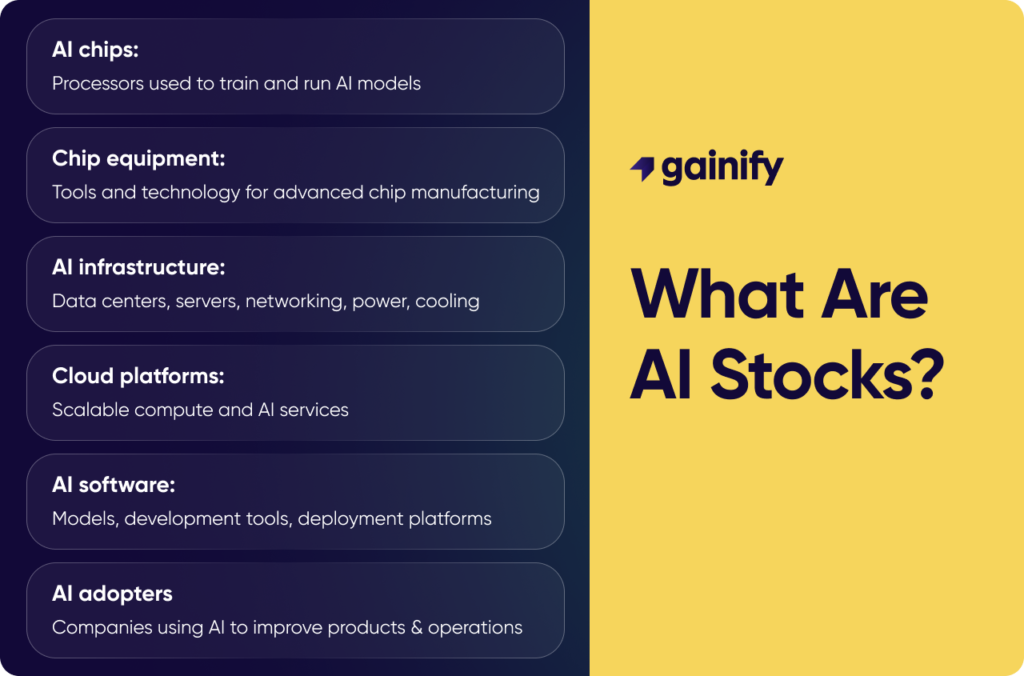
They generally fall into the following categories:
- Chip designers and manufacturers: Companies that build the processors used to train and run AI models
- Semiconductor equipment suppliers: Firms that provide the tools and technology required to manufacture advanced chips
- Data center and infrastructure providers: Businesses supplying servers, networking, storage, power, and cooling for AI workloads
- Cloud platforms: Companies offering scalable computing resources and AI services to enterprises
- AI software and model developers: Firms building AI models, development tools, and deployment platforms
- Enterprise and consumer adopters: Companies using AI to improve products, automate operations, or enhance decision-making
Not all AI exposure is equal. Some companies generate direct AI-driven revenue, while others benefit indirectly through productivity gains, cost reductions, or improved customer experiences. For investors, understanding where AI creates economic value within a company is more important than whether AI is mentioned in marketing materials.
How to Measure Financial Impact in AI Stocks
Investors evaluate AI stocks by measuring how artificial intelligence affects revenue, cost structure, productivity, and capital allocation, and whether those effects persist at scale. The evaluation focuses on financial statements and operating metrics rather than adoption narratives.
Revenue Impact From AI in AI Stocks
Revenue impact refers to AI-attributable sales that increase total revenue or pricing power. AI-driven revenue appears through product sales, usage-based fees, or contract expansion tied directly to AI functionality.
Investors assess revenue impact by examining.
- Portion of revenue explicitly linked to AI products or services.
- Usage-based or recurring revenue tied to AI workloads.
- Evidence of price increases justified by additional AI capabilities.
As reported in the McKinsey Global Survey on AI, 2025, revenue impact emerges earliest in infrastructure, platform, and tooling layers where AI demand is directly monetized.
Cost Savings and Productivity Effects in AI Stocks
Cost savings and productivity effects refer to structural reductions in operating expenses or increases in output per employee caused by AI deployment. These effects matter when they translate into sustained margin expansion.
Investors evaluate this through.
- Changes in operating and gross margins following AI rollout.
- Slower growth in headcount relative to revenue growth.
- Measurable improvements in throughput, cycle time, or error rates.
As reported in the Deloitte 2025 Global Generative AI Survey, the most consistently realized AI benefits at the enterprise level are operating cost reductions, labor efficiency gains, and faster cycle times, while direct revenue contribution remains concentrated in a smaller subset of scaled deployments.
Capital Allocation and Capital Intensity in AI Stocks
Capital allocation measures how artificial intelligence reshapes long-term investment priorities, particularly spending on compute infrastructure, data centers, proprietary software development, and data acquisition. In AI-driven business models, monetization follows capacity build-out, which makes upfront capital deployment a defining financial characteristic.
Key indicators investors track include.
- AI-related capital expenditures and multi-year investment programs.
- Return on invested capital as AI capacity scales from build-out to utilization.
- Balance between fixed infrastructure costs and variable, usage-linked revenue streams.
This dynamic is visible in hyperscale capital spending. Amazon, Alphabet, Microsoft, and Meta have all reported capital expenditure programs at historic highs, driven primarily by AI-related investments in data centers, custom silicon, networking, and power infrastructure. According to company filings and earnings guidance released with Q4 2025 results, annual capital spending at each of these firms is projected to exceed $100 billion in 2026, with elevated investment levels persisting as AI capacity continues to scale.
For investors, this analysis is central because shareholder returns in semiconductor, infrastructure, and cloud-related AI stocks depend on how efficiently large, AI-driven capital programs translate into sustained cash flow and attractive returns on invested capital.
Durability of Financial Impact in AI Stocks
Durability of financial impact means whether AI-driven revenue growth, cost savings, or productivity gains persist over time and support recurring cash flow. In investing terms, durability determines whether AI improves long-term valuation rather than delivering temporary efficiency gains.
Durable impact depends on how deeply AI is embedded in core operations, not on novelty or isolated use cases. Investors therefore focus on structural characteristics.
Key indicators include.
- Integration of AI into mission-critical workflows such as pricing, supply chains, underwriting, or product development.
- Control of proprietary data or long-term data access that sustains model performance.
- Stability of operating margins as AI adoption expands across the customer base.
Research by MIT Sloan Management Review and Boston University in 2023 shows that firms with deeply embedded AI systems sustain performance gains significantly longer than firms using standalone AI tools.
For investors, durability connects AI adoption to predictable cash flow, valuation resilience, and risk exposure, which leads directly into the risks and limitations of AI-focused investments.
How the AI Value Chain Works
The AI value chain explains how artificial intelligence converts capital spending and innovation into revenue, cost savings, and productivity gains across multiple economic layers. Value creation starts with semiconductor production, progresses through infrastructure and cloud platforms, and culminates in enterprise and consumer applications where monetization occurs.
1. Chip Designers and Semiconductor Manufacturers
Chip designers and semiconductor manufacturers form the foundation of the AI value chain because training and inference for modern AI models require highly specialized processors optimized for parallel computation and energy efficiency. Demand in this layer is driven by hyperscale cloud providers, large enterprises, and public-sector investment programs.
This segment exhibits several structural characteristics.
- High barriers to entry driven by design complexity, fabrication scale, and intellectual property.
- Periods of strong pricing power when advanced-node capacity is constrained.
- Multi-year demand visibility linked to large AI infrastructure build-outs rather than short-term consumption cycles.
Financial outcomes in this layer remain sensitive to product cycles, competitive dynamics, and valuation levels. As capacity expands and supply normalizes, revenue growth rates can decelerate even when AI adoption continues.
Representative semiconductor stocks in this layer include NVIDIA, Advanced Micro Devices, Intel, and Taiwan Semiconductor Manufacturing Company.
2. Semiconductor Equipment and Manufacturing Suppliers
Semiconductor equipment suppliers enable AI chip production by providing the tools required for lithography, deposition, etching, and inspection. Without continued investment in this equipment, leading-edge AI processors cannot be manufactured at scale.
Economic value in this subsector is shaped by several factors.
- Long-duration customer relationships supported by high switching costs and technical integration.
- Exposure to both leading-edge and mature-node investment cycles.
- Revenue driven primarily by long-term capacity expansion rather than short-term end demand.
This segment often displays more stable cash flow characteristics because it captures spending across multiple chip designers rather than relying on the success of individual architectures.
Representative companies include ASML, Applied Materials, Lam Research, and KLA.
3. Data Center and AI Infrastructure Providers
AI workloads impose extreme requirements on power delivery, cooling, networking, and physical footprint. As a result, AI infrastructure stocks like data center and infrastructure providers have become critical enablers of AI scale.
Economic value in this layer arises from structural demand drivers.
- Persistent expansion of global data center capacity.
- Rising demand for high-performance networking and energy-efficient systems.
- Revenue models supported by long-term contracts and recurring services.
Compared with pure hardware providers, this segment often delivers steadier cash flows because utilization and service revenues smooth cyclicality.
Representative AI data center stocks include Super Micro Computer, Arista Networks, Vertiv, and Equinix.
4. Cloud Platforms and Hyperscalers
Cloud platforms connect AI infrastructure with enterprise demand by providing on-demand compute, storage, and AI services. This layer absorbs the largest share of AI-related capital expenditure and acts as the primary distribution channel for AI workloads.
Financial performance in this segment reflects several dynamics.
- High and sustained capital requirements to expand AI capacity.
- Monetization efficiency across compute, storage, and AI-specific services.
- Competitive pricing pressure that influences margin structure.
Over time, differentiation depends less on raw compute availability and more on how deeply AI services integrate into enterprise systems and workflows.
Representative companies include Microsoft, Amazon, Alphabet, and Oracle.
5. AI Software and Model Platforms
AI software and model platforms convert infrastructure into usable business tools through development frameworks, data platforms, and proprietary models. This layer determines how easily enterprises can deploy AI at scale.
Economic outcomes depend on several structural elements.
- The ability to convert usage into recurring subscription or consumption-based revenue.
- Integration depth within core customer workflows.
- Margin expansion as model reuse increases and unit inference costs decline.
Competition remains intense, but platforms that achieve workflow integration and switching costs can sustain durable revenue streams.
Representative companies include Palantir Technologies, Snowflake, Datadog, and C3.ai.
6. AI-Enabled Applications and End-Market Adopters
AI-enabled application companies apply artificial intelligence to specific use cases across software, industrial systems, healthcare, and consumer products. This layer represents the final point of monetization.
Economic impact varies widely across companies because AI often enhances existing products rather than acting as a standalone revenue source.
- Financial benefits frequently appear as margin expansion, automation-driven cost reduction, or improved customer retention.
- Revenue attribution to AI remains uneven and difficult to isolate in many sectors.
Sustained value creation occurs when AI meaningfully alters unit economics or competitive positioning.
Representative companies include CrowdStrike, Intuit, AI healthcare stocks like Intuitive Surgical, Tesla, and AI defense stocks where public-sector adoption is expanding.
Value Chain Layer | Economic Function | Primary Revenue Driver | Financial Characteristics | Representative AI Companies |
Chip Designers and Semiconductor Manufacturers | Produce specialized processors required for AI training and inference | Demand from hyperscalers, enterprises, governments | High barriers to entry, cyclical growth, pricing power during capacity constraints | NVIDIA, Advanced Micro Devices, Intel, Taiwan Semiconductor Manufacturing Company |
Semiconductor Equipment Suppliers | Provide lithography, deposition, etching, and inspection tools required to manufacture advanced chips | Long-term fab capacity expansion | High switching costs, recurring tool demand, exposure to industry-wide capex cycles | ASML, Applied Materials, Lam Research, KLA |
Data Center and AI Infrastructure Providers | Supply servers, networking, cooling, power systems, and colocation capacity | Structural growth in AI-driven data center expansion | Recurring contracts, utilization-based revenue, steadier cash flows than chip cycles | Super Micro Computer, Arista Networks, Vertiv, Equinix |
Cloud Platforms and Hyperscalers | Deliver on-demand compute, storage, and AI services to enterprises | Consumption-based cloud and AI service usage | Very high capital expenditure, operating leverage at scale, margin sensitivity to pricing | Microsoft, Amazon, Alphabet, Oracle |
AI Software and Model Platforms | Convert infrastructure into deployable AI tools and development environments | Subscription and usage-based software revenue | High gross margins, workflow integration advantages, execution-sensitive growth | Palantir Technologies, Snowflake, Datadog, C3.ai |
AI-Enabled Applications | Apply AI within industry-specific products and services | Margin expansion, automation savings, product differentiation | Uneven revenue attribution, improvement in unit economics drives returns | CrowdStrike, Intuit, Intuitive Surgical, Tesla |
Risks and Challenges of Investing in AI Stocks
Risks and challenges of investing in AI stocks arise when financial outcomes from artificial intelligence fail to scale in proportion to valuation levels and capital deployed. In practical terms, AI investment risk is the gap between expected revenue growth, cost savings, or margin expansion and the actual cash flow generated from AI-related spending.
Valuation Risk of AI Stocks
Valuation risk refers to the downside created when equity prices already reflect optimistic assumptions about AI-driven growth. In this context, future returns depend less on whether AI adoption continues and more on whether adoption exceeds what is already priced in.
Valuation outcomes are determined by.
- The share of long-term AI revenue and margin expansion embedded in current multiples.
- The elasticity of valuation to changes in growth rates.
- Historical patterns of multiple compression during prior technology investment cycles.
Past cloud computing and semiconductor investment phases show that elevated starting valuations amplify downside even when absolute revenue growth persists.
Capital Intensity Risk
Capital intensity risk reflects the requirement for large upfront investment before AI-related cash flows materialize. AI-driven businesses deploy capital into compute, data centers, networking, energy infrastructure, and specialized labor well ahead of utilization.
Financial performance depends on.
- The timing mismatch between capital expenditures and operating cash inflows.
- Return on invested capital as AI capacity scales.
- The risk of persistent underutilization if demand growth underperforms.
Empirical analysis of infrastructure-heavy technology cycles demonstrates that elevated capital spending periods coincide with reduced near-term free cash flow and higher dispersion in equity returns.
Competitive and Technology Risk
Competitive and technology risk arises from rapid convergence in model capabilities and declining differentiation over time. As AI systems become more standardized, pricing power and margin expansion weaken.
Economic durability depends on.
- The speed at which competitors replicate core AI functionality.
- Revenue concentration among a limited set of customers or platforms.
- The depth of AI integration into core business processes rather than modular or replaceable tools.
Firms that embed AI into mission-critical workflows retain economic benefits longer than firms offering easily substitutable AI features.
Regulatory and Policy Risk
Regulatory and policy risk refers to constraints on AI deployment imposed by data governance, privacy requirements, and model accountability rules. These constraints directly affect cost structures and scalability.
Financial impact occurs through.
- Higher compliance and monitoring expenses.
- Limits on data access and model training.
- Delays in commercialization and geographic expansion.
Taken together, these risks explain why AI investment performance diverges sharply across companies and market cycles. Shareholder returns depend on how effectively AI-related spending converts into durable cash flows, capital efficiency, and defensible margins, which directly informs allocation decisions across different layers of the AI value chain.
How to Build AI Exposure Using AI Stocks
Rather than treating AI as a single bet, investors often approach it as a portfolio allocation decision. The goal is to balance upside from innovation with risk control across the AI value chain.
Below is a practical way investors typically think about positioning.
Core AI Stock Exposure
Purpose: Capture long-term AI infrastructure growth
Core AI stock exposure captures long-term growth from AI infrastructure and compute build-outs. This layer sits at the lower end of the AI value chain, where spending is driven by multi-year capital investment programs.
Typical characteristics:
- High capital intensity and large upfront investment.
- Strong barriers to entry based on scale, engineering complexity, or manufacturing capability.
- Revenue visibility tied to data center expansion and compute demand rather than short-term adoption cycles.
These AI equities often form the structural foundation of an AI allocation and are typically held over longer horizons.
Growth Exposure
Purpose: Benefit from expanding AI usage and monetization
Growth-oriented AI equities capture expanding AI usage and monetization. This exposure targets software platforms, AI services, and cloud-layer businesses where revenue scales with deployment and customer adoption.
Typical characteristics:
- Faster revenue growth rates.
- Higher operating leverage once fixed costs are absorbed.
- Greater sensitivity to competition, pricing pressure, and execution quality.
These positions drive upside but require active monitoring as growth expectations and margins evolve.
Selective Application Exposure
Purpose: Capture AI-driven business transformation
Selective AI application companies capture AI-driven productivity and margin improvement within specific industries. In this segment, AI enhances existing products or workflows rather than acting as a standalone revenue source.
Typical characteristics.
- Uneven financial impact across companies and sectors.
- Returns driven by cost savings, efficiency gains, or competitive differentiation.
- Strong dependence on industry structure and management execution.
Exposure at this layer is usually smaller and conviction-based rather than broadly diversified.
Risk Management Considerations
Risk control across AI stocks focuses on capital discipline rather than narrative exposure. Investors typically manage risk by:
- Diversifying across subsectors rather than concentrating in one theme
- Adjusting position sizes based on valuation and cycle stage
- Monitoring capital spending and cash flow trends closely
AI investing rewards patience, but it also requires discipline as expectations evolve.
Integrating AI Equities Into a Portfolio
Integrating AI equities into a portfolio reflects how AI value shifts over time. Early in adoption cycles, infrastructure and compute-focused AI stocks capture most economic value. As deployment broadens, software platforms and application-level AI companies contribute more to returns.
Combining AI stocks across layers aligns portfolio exposure with the financial realities of AI adoption rather than relying on a single outcome or timing assumption.
AI Stocks vs AI ETFs: Choosing the Right Approach
There is no single best way to invest in artificial intelligence. Some investors prefer the precision and upside potential of individual AI stocks, while others favor the diversification and simplicity of AI-focused exchange-traded funds. The right approach depends on risk tolerance, time horizon, and how actively an investor wants to manage positions.
Understanding the trade-offs between these two options helps investors decide how to structure AI exposure within a broader portfolio.
Key Differences Between AI Stocks and AI ETFs
Aspect | AI Stocks | AI ETFs |
Type of exposure | Individual companies within the AI ecosystem | Basket of AI-related companies |
Diversification | Low to moderate (company-specific risk) | High (spread across many firms and subsectors) |
Upside potential | Higher if a company significantly outperforms | More limited due to diversification |
Risk level | Higher volatility and execution risk | Lower single-stock risk |
Research required | Ongoing company-level analysis | Minimal ongoing research |
Valuation sensitivity | High, especially for growth stocks | Moderate |
Subsector targeting | Precise (chips, infrastructure, software, applications) | Limited by fund composition |
Fees | None beyond trading costs | Ongoing expense ratios |
Best suited for | Active, conviction-driven investors | Long-term, diversified investors |
How Investors Often Combine Both
Many investors use AI ETFs as a core allocation to gain broad exposure to the AI theme, while adding select AI stocks as satellite positions to target specific subsectors or high-conviction opportunities. This blended approach can help balance long-term participation in AI growth with risk management as the market evolves.
AI Stocks Q&A
What is an AI stock?
An AI stock is a company that either already generates material revenue directly linked to artificial intelligence or is allocating significant capital toward AI capabilities with the explicit objective of producing scalable AI-driven revenue, cost efficiencies, or productivity gains. In financial terms, AI must influence revenue mix, margin structure, or capital expenditure priorities in a measurable way.
Does a company need current AI revenue to qualify?
No. A company qualifies if its capital allocation, research and development spending, infrastructure investment, or product roadmap clearly targets future AI monetization. The key requirement is a defined economic pathway from AI investment to revenue growth, margin expansion, or long-term cash flow generation.
Where does AI monetization typically appear first?
AI monetization typically appears first in semiconductors, data center infrastructure, and cloud platforms. These businesses generate revenue by supplying compute capacity, networking equipment, storage, and AI-specific services required to train and run models. Their revenue scales directly with AI adoption because customers must purchase capacity before deploying applications.
Why is AI revenue slower to emerge at the application layer?
Application-layer companies often deploy AI initially to automate workflows, reduce labor intensity, improve decision-making, or enhance existing products. Financial impact therefore first appears as cost reduction or operating margin improvement rather than immediate incremental revenue. Only after integration deepens does AI begin contributing meaningfully to top-line growth.
What matters most when evaluating AI stocks?
The most important factors are capital efficiency, return on invested capital, and the durability of AI-related revenue streams. Investors examine whether AI spending translates into sustained revenue growth, stable margins, and expanding free cash flow rather than temporary demand spikes or experimental initiatives.