



Dividend stocks and growth stocks are often discussed as if investors must choose between two opposing camps. In practice, this framing misses how capital is actually compounded over long periods.
Both dividend and growth stocks can create significant wealth, and both can underperform badly when misunderstood or misapplied.
At a fundamental level, dividend and growth stocks represent two different mechanisms for translating business success into shareholder returns. One emphasizes immediate cash distribution. The other emphasizes reinvestment for future cash generation. Understanding how, when, and why each mechanism works is far more important than the label attached to the stock.
This article looks beneath the labels, focusing on the business economics, capital decisions, and risks that determine whether dividends or growth truly deliver long-term returns.
Highlights: What Actually Drives Results
- How capital is used: Dividends and growth simply reflect what a company does with the cash it generates
- Where returns come from: Long-term returns depend on when cash is received, how well it is reinvested, and the price paid
- Adjusting over time: Strong portfolios change as markets, valuations, and opportunities evolve
What Dividend Stocks Really Represent
Dividend stocks are companies that generate consistent free cash flow beyond what they can reinvest productively. Paying a dividend is not a sign of stagnation. It is a clear capital allocation choice that returning excess cash to shareholders is the most efficient way to create value at the current stage of the business.
These companies typically operate in stable, well-established markets where demand is predictable and competitive positions are durable. They tend to share several defining characteristics:
- Stable demand and pricing power, often tied to essential or recurring products
- Mature operating models with predictable margins and cost structures
- Capital expenditures well below operating cash flow, creating surplus cash
- Balance sheets designed to support recurring distributions across cycles
Common examples include consumer staples companies, regulated utilities, large telecommunications providers, integrated energy firms, and established pharmaceutical or financial institutions. The objective of these businesses is not rapid expansion, but reliable cash generation and disciplined capital return.
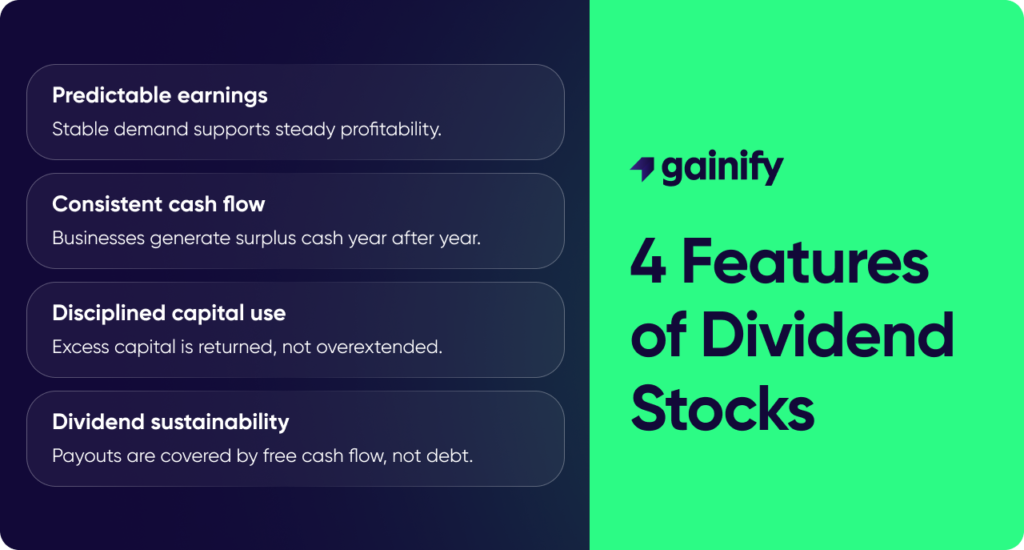
Dividends play two important roles. They return capital directly to shareholders, reducing dependence on future valuation expansion, and they impose discipline on management. Once a dividend is established, capital allocation decisions must account for sustaining that payout, which often limits excessive leverage, speculative acquisitions, or unfocused growth initiatives.
The value of a dividend depends entirely on its sustainability. High yields funded by borrowing, asset sales, or weakening cash flows often signal risk rather than opportunity. Effective dividend analysis therefore focuses on free cash flow coverage, payout ratios through economic cycles, and balance sheet flexibility, not headline yield alone.
At their best, dividend stocks aim to deliver reliable income, controlled risk, and steady long-term compounding, making them particularly effective when stability and cash flow durability are priorities.
Examples of Dividend Stocks
- Procter & Gamble (NYSE:PG): brand strength and everyday consumer demand support stable cash flows and long-term dividend growth.
- Johnson & Johnson (NYSE:JNJ): a diversified healthcare portfolio provides resilient earnings and consistent capital returns.
- Verizon Communications (NYSE:VZ): recurring subscription revenues and regulated market dynamics support reliable dividend payouts.
- JPMorgan Chase & Co. (NYSE:JPM): scale, diversified earnings, and strong capital buffers enable sustainable dividends across cycles.
What Growth Stocks Actually Ask of Investors
Growth stocks are companies that reinvest most of their earnings back into the business to expand revenue, earnings, and competitive advantage. Instead of returning cash today, they aim to increase the size and profitability of the business so that future cash flows are substantially larger. Investors in growth stocks accept limited or no near-term income in exchange for this long-term compounding potential.
These companies typically operate in expanding markets or are gaining share within existing ones. They often exhibit:
- Revenue and earnings growth above market averages, driven by new products, services, or geographic expansion
- High reinvestment rates, particularly into research and development, capacity, technology, or customer acquisition
- Durable competitive advantages, such as network effects, intellectual property, or scale, that allow reinvestment at attractive returns
- Valuations anchored in future expectations, with much of today’s price reflecting cash flows several years out
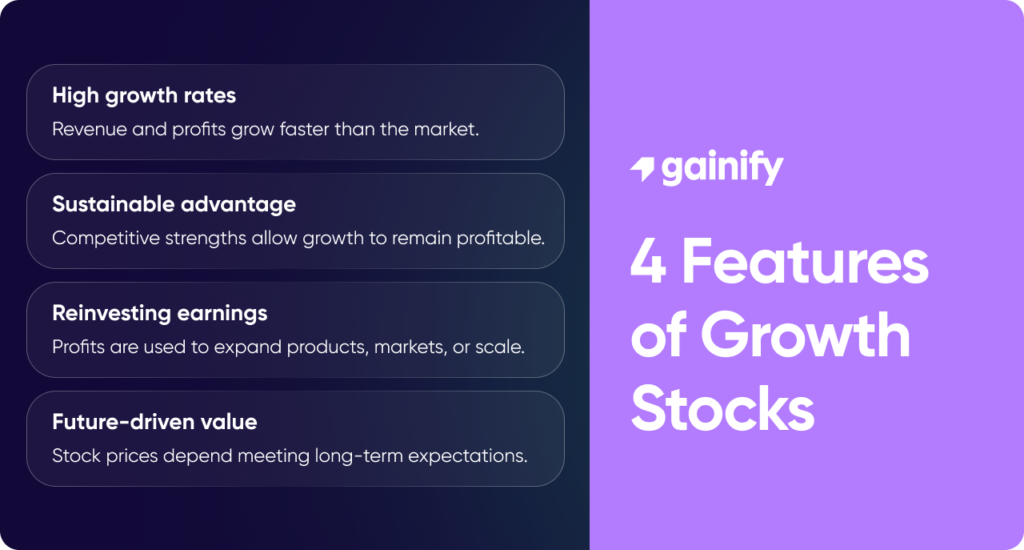
Owning growth stocks is fundamentally an exercise in managing expectations. Returns depend not only on whether the business grows, but on whether it grows faster, longer, or more profitably than the market already anticipates. Strong operational performance does not guarantee strong returns if expectations were too optimistic at the time of purchase.
Growth investing therefore requires continuous assessment of reinvestment efficiency, competitive dynamics, and market saturation. As growth rates naturally slow or opportunities narrow, valuation multiples often adjust downward before earnings do. The most successful growth investors focus not just on growth itself, but on the sustainability and return on that growth.
Examples of Growth Stocks
- NVIDIA (NASDAQ:NVDA): heavy reinvestment into advanced computing and AI platforms fuels rapid revenue growth and expanding profit pools.
- Amazon.com (NASDAQ:AMZN): cash flows are continuously reinvested into logistics, cloud infrastructure, and new services to maximize long-term scale.
- Alphabet (NASDAQ:GOOG): Strong operating cash flow is directed toward core platforms, cloud, and emerging technologies to extend growth duration.
- Meta Platforms (NASDAQ:META): Significant reinvestment into advertising infrastructure, AI, and new platforms prioritizes future earnings growth over current distributions.
The Economics of Dividends vs Growth
The difference between dividend and growth stocks is economic, not philosophical. It comes down to where capital earns the highest return.
- Dividend stocks operate on the assumption that shareholders can reinvest excess cash more effectively outside the business.
- Growth stocks operate on the assumption that management can reinvest capital internally at superior and durable returns.
Growth makes sense when reinvested capital consistently earns returns well above the company’s cost of capital. Dividends become the more rational choice when incremental opportunities deliver lower returns, become less certain, or increase risk without proportionate reward.
This framework also explains why many successful companies evolve over time. Early in their lifecycle, businesses reinvest aggressively to capture growth. As markets mature and expansion opportunities narrow, free cash flow increases and capital returns shift toward dividends or buybacks. This transition often reflects capital discipline and economic maturity, not declining business quality.
Risk: Visibility Versus Sensitivity
Dividend Stock Risk
Dividend stocks tend to offer greater return visibility:
- Regular cash payments reduce reliance on future price appreciation
- Stable earnings often lead to lower volatility in normal conditions
They also carry distinct risks:
- Dividend cuts can trigger sudden and significant repricing
- High yields may hide weakening fundamentals
- Debt used to support payouts can magnify downturns
Investors should focus on free cash flow coverage, leverage trends, and earnings cyclicality. The most dangerous dividend stocks are those where yields rise because share prices fall faster than the underlying business deteriorates.
Growth Stock Risk
Growth stocks tend to offer greater upside sensitivity:
- Returns are driven by expectations of future earnings expansion
- Valuation reflects cash flows projected many years ahead
They also carry distinct risks:
- Rising interest rates reduce the value of distant cash flows
- Competitive changes can shorten the growth runway
- Execution missteps can reset expectations quickly
Because future cash flows dominate valuation, even modest changes in outlook can lead to large price movements. Growth stocks often underperform not because the business fails, but because growth slows or expectations normalize.
Valuation: Where Most Errors Are Made
Valuation is the most common source of long-term underperformance in both dividend and growth investing. Neither a dividend yield nor a growth narrative compensates for paying the wrong price.
Dividend Valuation Risks
Dividend stocks often appear attractive when yields are high, but elevated yields are frequently a warning signal rather than an opportunity. When yield rises sharply, it is usually because the share price has fallen, often reflecting:
- Deteriorating cash flow visibility
- Rising leverage or refinancing risk
- Structural changes in the business model
- Increased payout saying more about pressure than confidence
In these cases, the market may already be questioning sustainability. A dividend that looks attractive on paper can quickly become irrelevant if it is reduced or eliminated. Yield-focused investors who ignore free cash flow coverage, balance sheet resilience, and cyclicality often mistake financial stress for value.
Dividend stocks also become vulnerable when optimism compresses yields too far. When stable businesses are priced as if cash flows are guaranteed indefinitely, even small disappointments can lead to meaningful repricing.
Growth Valuation Risks
Growth stocks tend to be mispriced for different reasons. Overvaluation often stems from extrapolating current growth too far into the future, assuming:
- Competitive advantages remain unchanged
- Market saturation does not occur
- Reinvestment returns stay elevated indefinitely
Growth valuations embed assumptions about duration, margins, and capital efficiency. When any one of those assumptions weakens, valuation multiples often adjust sharply, even if the business continues to grow.
Another common risk is mistaking revenue growth for value creation. Growth funded through heavy dilution, aggressive acquisitions, or declining returns on capital can expand the business while destroying shareholder value.
Portfolio Construction: Why Blending Works
Well-constructed portfolios rarely rely on a single style. Dividend and growth stocks serve different economic roles, and combining them improves resilience across market environments.
Dividend stocks contribute:
- Reliable cash flow, which can be reinvested opportunistically or used to reduce risk
- Lower volatility, particularly during periods of economic or market uncertainty
- Downside cushioning when valuations compress or growth expectations reset
Growth stocks contribute:
- Exposure to long-term structural expansion, including innovation and market share gains
- Inflation resilience, as earnings growth can offset rising costs over time
- Long-duration compounding, which drives a disproportionate share of long-term returns
The optimal mix between dividend and growth stocks is not fixed. It shifts as valuations change, interest rates move, and the opportunity set evolves. Periods of extreme valuation dispersion often reward flexibility, while rigid, static allocations tend to underperform when market conditions change.
Blending is not about balance for its own sake. It is about aligning sources of return with prevailing risks and expected rewards.
When Each Style Tends to Perform Best
When Dividend Stocks Tend to Lead
Dividend stocks tend to outperform in environments where predictability and cash flow reliability are rewarded more than rapid expansion. This typically occurs when:
- Economic growth slows or becomes uncertain, increasing the value of stable earnings
- Interest rates stabilize or decline, improving the relative appeal of income-generating assets
- Investors favor dependable cash flows, rather than distant or uncertain growth
In these conditions, valuation discipline matters more than narrative. Companies that consistently convert earnings into cash are often favored over those relying on future expansion to justify valuations.
When Growth Stocks Tend to Lead
Growth stocks tend to outperform when future earnings are valued more highly and reinvestment opportunities expand. These environments often include:
- Accelerating economic or sector-specific growth, which supports sustained revenue expansion
- Abundant and inexpensive capital, lowering the discount rate applied to future cash flows
- Innovation-driven market expansion, increasing addressable markets and growth duration
Under these conditions, long-duration earnings streams and effective reinvestment are rewarded, and companies with strong growth engines can generate outsized returns.
Final Perspective: Dividend vs Growth Is a False Choice
The most effective investors do not anchor their identity to dividend or growth labels. They concentrate on how a business creates value and how that value is ultimately delivered to shareholders.
Dividend stocks tend to perform best when cash flows are durable and incremental reinvestment opportunities offer diminishing returns. Growth stocks tend to perform best when reinvested capital earns high, repeatable returns over long periods. Problems arise when visibility is mistaken for safety, or when growth is assumed to persist without regard for competition, valuation, or capital intensity.
Long-term capital is compounded by understanding business economics, applying valuation discipline, and adjusting exposure as opportunities and risks evolve. The distinction between dividend and growth matters far less than whether capital is being allocated to its most productive use at the right price.
Q&A: Dividend vs Growth Stocks
Q: Are dividend stocks safer?
A: They offer more visible cash returns, but dividend cuts can erase years of income quickly.
Q: Do growth stocks always win long term?
A: Only when reinvestment returns remain high and expectations remain reasonable.
Q: Can one company be both?
A: Yes. Many high-quality companies grow earnings while paying rising dividends, offering a balanced return profile.
Q: How should allocation change over time?
A: As valuations, rates, and personal cash needs evolve, the balance between dividend and growth exposure should evolve as well.
Q: What matters more: yield or growth rate?
A: Neither alone. Total return relative to risk and price paid is what ultimately matters.