


The phrase “penny stocks to buy now” implies immediacy and clarity in a segment of the market defined by uncertainty. Penny stocks operate where liquidity is thin, information is uneven, and outcomes are highly sensitive to timing and structure. In this environment, price alone is a poor signal.
What determines results is context: whether risk is contracting or expanding, how expectations are positioned, and whether the company’s financial and capital structure allows operational progress to accrue to shareholders. In penny stocks, value emerges not from stories, but from changes in conditions.
This guide is not a list. It is a decision framework designed to identify when penny stocks become investable and when they remain structurally flawed. It focuses on the signals that precede sustainable opportunity and the risks that quietly undermine it. In this market, durable outcomes are created through discipline, selectivity, and patience, not prediction.
Key Highlights
- Penny stocks are condition-driven, not price-driven. Opportunity emerges when risk contracts and expectations reset, not simply because a stock trades cheaply.
- Structure precedes upside. Balance sheet strength and capital discipline determine whether improving operations translate into shareholder value.
- Timing creates asymmetry. The best setups appear when fundamentals improve quietly, before liquidity and attention return.
What Is a Penny Stock?
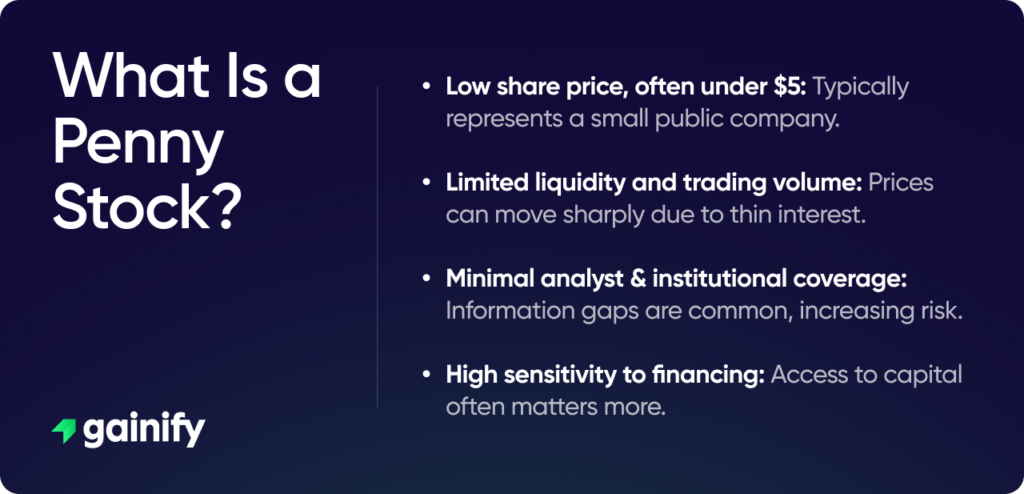
A penny stock is typically defined as a stock that trades at a low absolute share price, often below five dollars, and represents a company with a small market capitalization and limited trading liquidity. While price is the most visible characteristic, it is also the least informative.
What truly defines a penny stock is market structure. Penny stocks usually operate in an environment with:
- Low average trading volume and wide bid–ask spreads
- Limited analyst coverage and institutional ownership
- Higher sensitivity to capital availability and financing terms
- Greater information asymmetry between buyers and sellers
Because of these characteristics, penny stocks behave differently from larger, more established companies. Price movements are often amplified, fundamentals take longer to be recognized, and outcomes are heavily influenced by access to capital rather than operating performance alone.
It is also important to distinguish between low-priced stocks and high-risk stocks. Not every low-priced stock is speculative, and not every speculative stock trades at a low price. A company trading at two dollars with stable cash flows and clean disclosure can be far less risky than a company trading at fifty dollars with high leverage and opaque accounting.
In practice, penny stocks represent the earliest, most fragile stage of the public equity market. They offer potential upside precisely because they lack liquidity, coverage, and certainty. At the same time, those same features make disciplined analysis and risk control essential.
What “Penny Stocks to Buy Now” Really Implies
In efficient markets, valuation gaps tend to close gradually as information is absorbed and capital reallocates. Penny stocks behave differently. They often trade sideways for extended periods, then reprice suddenly when a small number of variables change. As a result, timing and setup often matter more than precise valuation.
When evaluating penny stocks to buy now, the core questions are not about which stocks look cheap, but about how underlying conditions are evolving:
- Where has risk declined in a durable way without the price fully adjusting?
- Which companies have moved beyond survival concerns and into a phase where execution drives outcomes?
- Where do expectations remain anchored to past problems despite clear signs of improvement?
The emphasis on now reflects the cyclical and path-dependent nature of penny stocks. These opportunities tend to appear briefly, when risk has fallen but optimism has not yet returned. Outside of those windows, penny stocks are usually either structurally too risky or already priced for success, leaving little room for favorable asymmetry.
The Core Filters Before You Buy
There are a few basic checks that need to be passed before a penny stock is worth considering. These checks should be done in order.
First, the company must be able to stay alive.
Second, the market must not already expect success.
Third, the business must be showing real signs of improvement.
Fourth, the share structure must allow investors to benefit if things improve.
If any one of these breaks, the investment usually does not work.
1. Financial Stability Comes First in Penny Stocks
The first thing to check is whether the company can keep operating. Many penny stocks fail simply because they run out of cash, not because the idea is bad.
A company needs enough time and funding to fix problems, grow, or even just stabilize. If it cannot survive long enough, nothing else matters.
Before buying, look at these basics:
- Cash runway: how much cash the company has compared to how fast it is spending it. This tells you how many months it can operate without raising more money.
- Access to capital: whether the company has been able to raise money recently, and on what terms. This helps you judge if future funding is realistic.
- Balance sheet risk: debt, obligations, or financial structures that could force dilution or cause trouble if conditions worsen.
- Reporting and compliance: whether the company files on time, reports clearly, and follows basic regulatory rules.
If the company cannot reasonably fund itself for the next 12 to 18 months, stop the analysis. In penny stocks, running out of money usually wipes out shareholders. Financial stability is not a bonus. It is a minimum requirement.
2. Why Low Expectations Matter in Penny Stocks
Good penny stock opportunities usually do not feel exciting.
By the time a stock attracts attention, expectations are often already high, and much of the upside is gone. Prices move when expectations change, not just when news is released.
Penny stocks that are worth looking at often show these signs:
- Long periods of weak or flat prices, showing that investors have been disappointed for a while.
- Low trading volume that is no longer falling, suggesting most sellers may already be out.
- Little investor attention, with few people actively talking about the stock.
- Very little promotion, reducing the chance that the price is driven by hype.
This setup matters because it does not take much good news to surprise the market. When optimism starts to show up clearly in volume, messaging, or headlines, the opportunity is often already shrinking.
3. Identifying Early Business Improvement
Penny stock investing is not about finding perfect companies. It is about spotting early improvement before the market reacts.
At this stage, progress matters more than polish. Look for simple, measurable changes in the business:
- Revenue stabilizing, where declines slow down or stop.
- Margins improving, showing better pricing or better cost control.
- Cash burn shrinking, meaning the company is spending less to operate.
- Milestones being met, where management does what it says it will do.
These changes usually appear first in financial statements and filings, not in headlines. Once improvement becomes obvious in the stock price or media, much of the opportunity is already reflected.
4. How Capital Structure Affects Returns
Even if a business improves, shareholders do not always benefit. In penny stocks, how the company is financed often matters more than how well it operates.
Before buying, review the share structure carefully:
- Fully diluted share count: how many shares could exist after conversions and exercises, not just today’s number.
- Convertible debt terms; prices and conditions that allow lenders to turn debt into shares, often at the expense of existing holders.
- Warrants and overhangs: shares that can be issued later and may limit upside or create selling pressure.
- Management incentives: whether insiders own shares and benefit from long-term value, or mainly from repeated financings.
A company can improve its business and still deliver poor returns if dilution is heavy. This is why capital structure review is a core step. It removes many penny stocks from consideration before any upside story should be taken seriously.
Risk Management Is Not Optional
In penny stocks, risk is not an exception. It is the baseline. There is no such thing as a safe penny stock, only managed exposure to uncertainty.
Experienced investors build their approach around two core assumptions:
- Some positions will fail completely, regardless of analysis or intent.
- A small number of successful outcomes will drive the majority of returns.
Because of this, risk management is not a defensive afterthought. It is the strategy.
Professionals manage risk through:
- Conservative position sizing, ensuring no single position can materially impair the portfolio.
- Diversification across uncorrelated ideas, reducing dependence on any one outcome or theme.
- Predefined exit rules, based on structural deterioration or thesis violation rather than price alone.
- Emotional detachment from individual positions, allowing decisions to remain process-driven rather than reactive.
In penny stocks, capital preservation is what creates optionality. Surviving periods of failure is what allows investors to participate when genuine opportunity appears.
Understanding the Risk Profile of Penny Stocks
Penny stock investing sits at the far end of the risk spectrum in public markets. These companies often operate with limited capital, short or uneven operating histories, and restricted access to financing. Liquidity is frequently thin, bid–ask spreads can be wide, and price movements can be abrupt and severe, making positions difficult to manage under stress.
Negative developments such as failed financings, regulatory setbacks, or execution missteps can lead to rapid and permanent impairment of capital. In many cases, outcomes are binary: a company either stabilizes and progresses, or it fails outright. This creates a return profile where a small number of successful investments must offset a larger number of losses.
Because of this structure, penny stock investing requires a fundamentally different mindset. Discipline, risk control, and acceptance of volatility are not optional. They are prerequisites. Investors who approach this segment without clear limits, realistic expectations, and a process designed to absorb failure are unlikely to sustain long-term success.
Final Perspective: What to Look For Before You Buy
The best penny stocks to buy now are rarely obvious and are never without risk. They do not announce themselves through excitement or attention. They emerge quietly, at the intersection of improving fundamentals and restrained expectations.
The most compelling setups tend to appear when:
- Business fundamentals are improving incrementally, even if results remain imperfect.
- Capital structures are stabilizing, reducing dilution and survival risk.
- Market expectations remain deeply depressed, leaving room for positive surprise.
- A credible path to repricing exists, supported by structural or operational change.
When approached with discipline, “penny stocks to buy now” stops being a speculative search phrase and becomes a structured analytical conclusion. In this part of the market, outcomes are shaped less by speed or bold conviction and more by a repeatable process, patience through uncertainty, and selectivity applied when attention is elsewhere.
Important Risk Disclosure
Penny stock investing involves a high degree of risk and is not suitable for all investors. Companies in this segment often have limited operating histories, fragile financial positions, and constrained access to capital. Liquidity can be thin, price movements can be extreme, and negative developments may lead to rapid and permanent loss of invested capital, including total loss.
Penny stocks are frequently subject to dilution, financing risk, regulatory uncertainty, and heightened volatility. Outcomes are often binary, with a small number of successes offset by numerous failures. Past performance, analysis, or perceived improvements do not guarantee future results.
This content is provided for educational and informational purposes only and does not constitute investment advice, a recommendation, or a solicitation to buy or sell any security. Readers should conduct their own independent research and consider consulting a qualified financial professional before making any investment decisions.