


Most people approach investing backwards. They jump straight to “investing” without understanding the mechanism that actually creates wealth. The truth is far more grounded:
Stocks can make you rich, but only if you use them in a way that most investors never do.
Wealth in public markets doesn’t come from hype, luck, or guessing winners. It comes from structure, discipline, and compounding over long periods of time.
It rewards consistency.
It punishes emotional decision-making.
This article breaks down the strategic logic of how wealth is truly created in equities, the behaviors that quietly destroy it, and the exact steps you should take if you’re not investing yet but want to build meaningful financial freedom.
1. What “Rich” Actually Means in the Context of Investing
Most people think of being “rich” as a sudden event or a single successful investment.
In a professional investment framework, wealth is not defined by a moment but by a set of financial characteristics that provide stability and flexibility.
Being rich typically reflects several conditions.
First, a portfolio must be able to grow independently of earned income. Your capital generates returns without relying on your labor, which means wealth continues to build even if employment changes or pauses.
Second, assets must compound reliably over long periods. The driver of wealth is not short-term market movement but long-term return dynamics based on diversification, reinvestment, and discipline.
Third, the portfolio must include enough liquidity and diversification to absorb market or personal shocks. A financially secure investor can withstand temporary volatility without being forced to sell assets at unfavorable prices.
Fourth, wealth must translate into meaningful optionality. This includes the ability to change careers, relocate, reduce working hours, or retire earlier without jeopardizing long-term financial stability.
To provide a practical benchmark, many financial professionals consider an individual to be genuinely “wealthy” when they hold approximately two million U.S. dollars in investable net assets, separate from the primary residence. When allocated thoughtfully, this level of capital can generate a significant annual return that meaningfully supplements or replaces earned income. It also provides enough resilience to compound over time without requiring aggressive risk-taking.
Importantly, richness in investing is not defined by a single number but by the relationship between capital, time, risk tolerance, and lifestyle costs. For some individuals, one million euros provides substantial freedom. For others, especially in high-cost environments, the threshold for financial independence may be higher. Regardless of the exact figure, the principle remains:
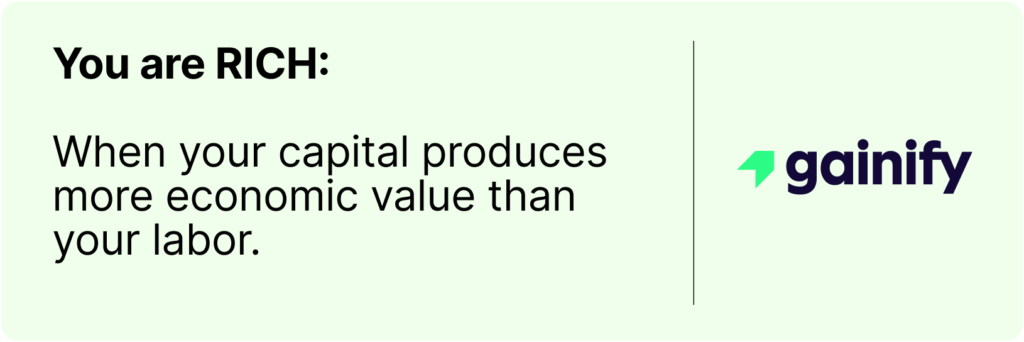
You are rich when your capital produces more economic value than your labor.
Reaching this state rarely requires extraordinary investment outcomes. What matters is consistent compounding, controlled risk, and avoiding the behavioral mistakes that prevent most investors from fully participating in long-term market growth.
2. How Stocks Build Wealth (The Engines Most Investors Underestimate)
Wealth creation in equity markets is not driven by prediction or luck. It stems from a set of structural advantages that reward time, discipline, and consistency. These advantages are often underestimated, even by individuals who invest regularly. Understanding them is essential for anyone seeking long-term financial strength.
2.1. Compounding: The Primary Engine of Long-Term Wealth
Compounding is mathematically simple but psychologically difficult to appreciate. Small, steady returns accumulate in a way that becomes disproportionately powerful over long periods of time. Investors who consistently earn reasonable annual returns often outperform those who chase higher returns intermittently.
A straightforward illustration shows why:
- Monthly investment: 500 dollars
- Annual return: approximately 8 percent
- Time horizon: 30 years
- Ending value: more than 745,000 dollars
During the first decade, progress appears slow. In the later decades, growth accelerates sharply as returns generate additional returns. The compounding effect becomes the dominant contributor to wealth, exceeding the importance of individual investment choices.
Compounding is not exciting, but it is the mechanism through which meaningful long-term wealth is built.
2.2. Equities Provide Asymmetric Upside
Equity ownership offers a structural benefit that many asset classes cannot replicate. The potential loss is limited to the amount invested, while the potential gain is unlimited. This asymmetry allows long-term investors to capture significant growth without requiring perfect foresight.
A diversified portfolio reinforces this advantage:
- Underperforming companies decline but eventually become a small part of the portfolio
- Strong performers expand and compound for extended periods
A simple example makes this clear:
- An investor allocates 1,000 dollars to Beyond Meat, which later declines significantly from its peak valuation. The maximum loss is the initial 1,000 dollars, and as the stock contracts, its influence on the portfolio becomes minimal
- The same investor allocates 1,000 dollars to Nvidia, which compounds over multiple years and grows many multiples in value. There is no cap on Nvidia’s possible appreciation, and its contribution to the portfolio can far exceed the losses from weaker holdings
In practice, this means investors do not need to identify future market leaders in advance. Broad exposure ensures that when exceptional companies emerge, they contribute meaningfully to returns. Over time, a small number of outperformers often drive the majority of portfolio growth.
This asymmetry is a central reason why equities are an effective tool for building wealth.
2.3. Time and Tax Deferral Quietly Enhance Returns
Another advantage of long-term investing is the ability to allow gains to accumulate without interruption. Investors often underestimate the importance of simply holding assets through market cycles.
Several factors contribute to this:
- Not selling avoids realizing taxable gains prematurely
- Deferred taxation allows a larger base of capital to continue compounding
- Reduced trading minimizes friction, including fees and behavioral errors
When returns compound over decades without frequent withdrawals or reallocations, the long-term outcome is often superior to more active approaches. The key advantage is not complexity but continuity.
3. How Stocks Destroy Wealth (The Patterns That Undercut Most Investors)
Despite equities being one of the most reliable long-term wealth generators, many investors fail to benefit from them. The gap is rarely explained by market performance. It is explained by behavior. Markets compound; investors often interrupt that compounding at precisely the wrong moments.
3.1. Buying High and Selling Low: The Behavioral Trap
A recurring pattern undermines returns more effectively than any external risk factor:
- Momentum builds, confidence rises, and investors buy after prices have already appreciated
- Volatility returns, sentiment deteriorates, and investors sell precisely when valuations are most attractive
This pattern converts temporary drawdowns into permanent losses. It also creates a structural disadvantage: the investor is most exposed when risk is highest and least exposed when opportunity is greatest.
In effect, the compounding engine is not merely slowed. It is run in reverse.
Sophisticated investors understand that volatility is normal and often beneficial because it creates attractive entry points. Most individuals treat volatility as a signal to exit, and in doing so, they forfeit the very returns they seek.
As Warren Buffett, Chairman of Berkshire Hathaway, wrote in his 1986 letter to shareholders:
Our goal is more modest: we simply attempt to be fearful when others are greedy and to be greedy only when others are fearful.
3.2. Concentration Without a Framework: Fragility by Design
Concentration is not inherently reckless. Many exceptional investors run concentrated portfolios. What makes concentration dangerous for most people is the absence of a structured decision-making framework.
A durable portfolio requires:
- A valuation rationale
- Defined risk parameters
- Position sizing rules
- Diversification across economic drivers
- A clear thesis supported by fundamental evidence
Without these elements, concentration becomes indistinguishable from gambling. A single disappointing earnings cycle or an industry shift can erase years of progress.
Wealth creation favors resilience. A portfolio that can withstand errors is more powerful than one that relies on perfection.
3.3. Misuse of Leverage and Options: Accelerating the Wrong Risks
Leverage is a tool that magnifies outcomes. In capable hands, it can be used prudently. In inexperienced hands, it converts volatility into permanent capital loss.
Common failure points include:
- Increasing exposure without understanding liquidity or drawdown risk
- Using short-dated options that decay quickly and demand precise timing
- Leveraging positions in volatile assets without scenario testing
The result is often catastrophic: routine market fluctuations become margin calls, and recoverable drawdowns become unrecoverable losses.
For individuals aiming to accumulate wealth, the priority is not maximization of short-term returns but preservation of long-term compounding. Complexity rarely improves outcomes. Risk control almost always does.
4. A Clear, Practical Roadmap if You Do Not Currently Invest
Building wealth through equities is not a function of exceptional income or rare opportunities. It is a function of structure, discipline, and the elimination of avoidable errors. The following roadmap outlines a rational approach for individuals beginning their investment journey, grounded in principles that remain effective across market cycles.
Step 1: Establish a Financial Foundation Before You Invest

Long-term investing requires staying invested through uncertainty. This is only possible when personal finances are sufficiently resilient.
The first priority is not market exposure but stability.
A robust foundation includes:
- An emergency reserve covering three to six months of essential expenses. This is not excess caution. It is the buffer that prevents forced liquidation during downturns, which is one of the most destructive events in an investor’s life cycle.
- Elimination of high-interest debt. Debt compounding at double-digit rates erodes wealth faster than equities can create it. Reducing these liabilities is equivalent to earning a risk-free return equal to the interest avoided.
- Cash set aside for near-term obligations. Capital designated for expenses in the next one to three years should not be exposed to equity volatility. This separation keeps investment capital truly long-term.
A stable financial base acts as your risk-management system before you ever enter the market.
Step 2: Define Your Investor Profile With Honesty, Not Aspiration

Many investors choose strategies based on who they want to be, not who they are. Effective investing requires alignment with temperament, time availability, and tolerance for volatility.
Key distinctions:
- If you prefer simplicity and low maintenance, a diversified automated portfolio is optimal. These systems remove decision fatigue, reduce behavioral mistakes, and capture market returns efficiently.
- If you enjoy research and analysis, a hybrid structure works well: a disciplined core portfolio complemented by a small active allocation. This approach allows for intellectual engagement without jeopardizing long-term outcomes.
A strategy mismatched with temperament eventually collapses under stress. Sustainability, not ambition, determines long-term success.
Step 3: Construct a Robust Core Portfolio Designed for Permanence

Your core portfolio is the engine of wealth creation. Its purpose is not to impress but to endure.
A strong core should be:
- Broad in exposure, ideally capturing global or major regional equity markets. Broad exposure reduces reliance on any single geography or sector.
- Diversified across hundreds of companies, ensuring that no individual outcome can meaningfully impair long-term results.
- Low-cost, because fees compound negatively and quietly erode returns over decades.
- Automated, so contributions occur regardless of market sentiment. Automation converts discipline into a mechanism, removing emotion from the process.
A core portfolio should be structured to survive market cycles with minimal maintenance and no reactive changes.
Step 4: Introduce Active Investing With Discipline, Not Impulse

Active investing is valuable only when it complements, rather than competes with, the core. It should be approached as a controlled experiment within a defined risk framework.
A disciplined active sleeve follows several principles:
- Limit the allocation to five to twenty percent of total assets, ensuring that mistakes are survivable and that the core remains the primary driver of wealth.
- Apply explicit position sizing rules, preventing oversized bets that distort risk exposure.
- Document investment rationales before acting, ensuring decisions are driven by analysis rather than emotion or narrative.
- Frame the active sleeve as a learning process, not an accelerated path to wealth. The objective is skill development under controlled risk, not speculation.
The role of the active sleeve is to add nuance and optionality, not to compensate for a weak core strategy.
Step 5: Create a One-Page Investment Rulebook That Governs Decisions

Professional investors rely on mandates and constraints. Individual investors benefit from the same discipline.
A clear one-page rulebook should outline:
- Your long-term objectives, defined in concrete terms
- Your target asset allocation, specifying expected ranges
- Your contribution schedule, ensuring systematic capital deployment
- Your rebalancing process, including timing and thresholds
- Your conditions for selling, which should be based on thesis change, valuation, or life circumstances, not fear
- Your behavioral commitments, such as avoiding panic-driven decisions or headline-based adjustments
This framework reduces cognitive load during periods of stress and preserves consistency, which is one of the most important determinants of long-term returns.
Step 6: Rebalance, Review, and Adjust With Intent and Restraint

Wealth building is dynamic. Both markets and personal circumstances evolve.
However, change should be deliberate, not reactive.
A disciplined refinement process includes:
- Rebalancing once or twice per year, bringing the portfolio back to its target risk profile. Rebalancing forces a rational “buy low, sell high” mechanism that is difficult to execute emotionally.
- Reviewing contribution levels as income grows. Increasing savings rates over time accelerates wealth creation far more reliably than market timing.
- Assessing changes in risk tolerance, which may shift with family obligations, career stability, or age.
- Evaluating active positions against written criteria, not emotions or short-term performance. The goal is process improvement, not prediction.
- Updating your rulebook only when circumstances materially change, ensuring that adjustments are intentional, not the product of market noise.
This ongoing refinement keeps the strategy aligned with reality while preventing unnecessary intervention, which is often harmful to long-term returns.
5. Advanced Insights: How Professionals Think About Wealth Building
These frameworks can elevate your decision-making.
5.1. Your Career Is an Asset. Your Job Is a Cash Flow. Investing Converts It Into Capital.
For most individuals, the most valuable early-stage asset is not their investment portfolio but their ability to earn income. This stream of predictable cash flow can be transformed into long-term capital through consistent investing.
Key insights include:
- Your salary is effectively a bond-like asset: stable, recurring, and relatively low risk. It provides funding for long-term wealth creation.
- Investing converts earned income into ownership: equity stakes in productive global companies that grow and compound independently of your labor.
- This conversion process is the primary engine of financial independence: the sooner earnings are transformed into capital, the sooner compounding begins working in your favor.
Professionals recognize that the accumulation of capital is not only a market function. It is a strategic allocation of human capital into financial assets. The earlier this process begins, the more powerful the eventual compounding effect.
5.2. Path Matters. Early Volatility Is Not a Threat. It Is an Advantage.
Individual investors often fear downturns early in their investment journey. Professionals view them differently. The path of returns influences outcomes, and a volatile or negative early period can actually strengthen long-term results.
This counterintuitive dynamic occurs because:
- Lower prices allow accumulation of more shares with each contribution
- Subsequent recoveries apply higher returns to a larger base of shares
- Temporary declines increase future compounding potential rather than diminish it
In simple terms, early setbacks create favorable entry points. Markets that rise uninterrupted may feel comfortable, but they offer fewer opportunities to buy at attractive valuations. Over multi-decade horizons, early declines often lead to improved long-term outcomes.
Sophisticated investors understand that volatility is not synonymous with risk. It is a structural feature of markets that rewards those who remain consistent.
5.3. True Risk Is Permanent Loss of Capital. Volatility Is Part of the Game.
Many investors conflate price fluctuations with risk. In professional practice, these are distinct concepts. Volatility is expected. Permanent impairment is what matters.
True investment risk arises from:
- Excessive concentration in a small number of positions
- Paying unsustainable valuations for assets driven by narrative rather than fundamentals
- Using leverage without a clearly defined downside framework
- Exiting positions during periods of heightened fear
These behaviors convert temporary drawdowns into irreversible losses.
A diversified portfolio, built on reasonable valuations and managed with discipline, significantly reduces the likelihood of permanent impairment. Over long time horizons, this approach makes near-total loss of capital extremely unlikely.
Professionals evaluate risk not by how often prices move but by the possibility of outcomes that cannot be recovered. The distinction is essential for maintaining long-term compounding.
So, Can Stocks Make You Rich?
Yes, stocks can make you rich. But not through speculation, rapid trading, or luck.
Wealth in equities emerges from a disciplined framework applied over many years.
Stocks create meaningful wealth through:
- Compounding that accelerates over long time horizons
- Thoughtful asset allocation that aligns with personal objectives
- Consistent behavior, especially during periods of uncertainty
- Risk management that prioritizes permanence over excitement
- A multi-decade perspective that views volatility as normal, not disruptive
The market rewards investors who approach it as a long-term strategic system rather than a short-term prediction game.
Those who commit to process, patience, and discipline capture the returns that speculation rarely delivers.
Disclaimer
This article is for educational purposes only and does not constitute financial, investment, tax, or legal advice. Investing involves risk, including possible loss of capital. Past performance does not guarantee future results. Always consider consulting a qualified financial professional before making investment decisions.