
Investors searching for individual stocks face a structural problem: the global equity market contains tens of thousands of publicly listed companies, each with different financial profiles, growth trajectories, and risk characteristics. Without a structured filtering process, the search for attractive investments becomes inefficient, with decisions frequently shaped by headlines, social media discussions, or recent price action.
Professional investors rarely begin research with a specific company. Instead, they start with a screening process that systematically filters the investment universe based on predefined financial criteria. Screening reduces thousands of companies to a manageable list that matches the investor’s strategy.
Stock screeners address this by allowing investors to narrow the market using measurable financial criteria such as earnings growth, returns on capital, and balance-sheet strength. For example, an investor may screen for companies with double-digit revenue growth, return on equity above 15%, and low debt levels. This converts stock selection into a repeatable analytical workflow rather than an ad-hoc search.
This guide explains how to use stock screeners effectively, how professional investors structure their screens, and how to translate an investment strategy into measurable screening criteria.
Key takeaways
- Stock screening is the starting point of professional equity research. Analysts first filter the universe before performing deeper analysis.
- Screening should reflect investment factors. Most successful strategies target well-documented factors such as value, momentum, profitability, and growth.
- Stock screeners produce only candidate ideas. Each screened stock must be validated through financial and qualitative analysis.
- Filters must match your investment horizon. Long-term investors focus on fundamentals while traders prioritize liquidity and price momentum.
- Fewer, well-chosen filters produce better results. A small set of clearly defined criteria is usually more effective than applying dozens of filters simultaneously.
What is a stock screener?
A stock screener is a tool that filters a database of publicly traded companies using predefined investment criteria such as valuation multiples, profitability metrics, growth rates, dividend payment track record, technical indicators, or analyst forecasts.

The purpose of a stock screener is to identify companies that meet specific financial characteristics, enabling investors to focus their analysis on the most relevant opportunities.
Stock screening is widely used across the investment industry. Fundamental investors rely on it to identify undervalued companies, quantitative funds use it to construct factor-based portfolios, and traders use it to locate liquid securities with strong price momentum. For a more detailed explanation, see what is a stock screener.
Why should you use a stock screener?
Using a stock screener allows investors to filter the investment universe based on clearly defined financial characteristics. Instead of reviewing companies one by one, investors can apply specific investment criteria and quickly narrow thousands of publicly listed stocks to a manageable shortlist.
This structured filtering process improves efficiency and helps investors focus their research on companies that match their strategy. In practice, investors use stock screeners to identify businesses with specific financial attributes such as strong revenue growth, attractive valuations, high profitability, or low leverage.
The main advantages include:
- Efficient market coverage. Investors can filter thousands of publicly listed companies across global exchanges within seconds.
- Consistent investment criteria. The same financial rules can be applied across every company in the investment universe.
- Discovery of overlooked opportunities. Screening often highlights companies outside widely followed large-cap stocks.
- Structured research workflow. Investors move systematically from screening to deeper financial analysis.
This structured approach is widely used across the investment industry. Quantitative investing pioneer James O’Shaughnessy emphasizes the importance of systematic processes in stock selection:
What works on Wall Street is not magic or luck. It is disciplined, systematic investing.
— James O’Shaughnessy, What Works on Wall Street
However, stock screening does not replace analysis. A screener identifies potential investment candidates, but each company must still be evaluated through deeper financial and qualitative research before an investment decision is made.
How to use a stock screener
Using a stock screener effectively means turning your investment strategy into measurable investment criteria, then applying filters in a logical order to produce a shortlist you can analyze. The goal is not to “find the perfect stock” in the screener. The goal is to reduce the universe to a manageable set of candidates that fit your strategy.
To make the process easy to visualize, this guide uses the Gainify stock screener as an example. The steps apply to any stock screener with comparable filters and data.
Here are the main steps on how to use stock screeners:
- Choose a stock screener
- Define your investment strategy
- Select screening filters
- Set filter thresholds (minimum and maximum values)
- Generate and rank results
- Analyze shortlisted companies and perform deeper financial research
- Review results and refine filters as the strategy evolves
Each step plays a distinct role in narrowing the investment universe, improving signal quality, and reducing the chance of selecting stocks that only look good because of incomplete filtering.
1. Choose a stock screener
The first step is selecting a stock screener that provides the data coverage and filtering flexibility required for your investment process. A screener is only as useful as the financial data and ranking tools it offers. The practical question is straightforward: can the platform filter and rank stocks using the exact investment criteria your strategy depends on? If the required metrics are unavailable, the results will be incomplete regardless of how many companies the platform covers.
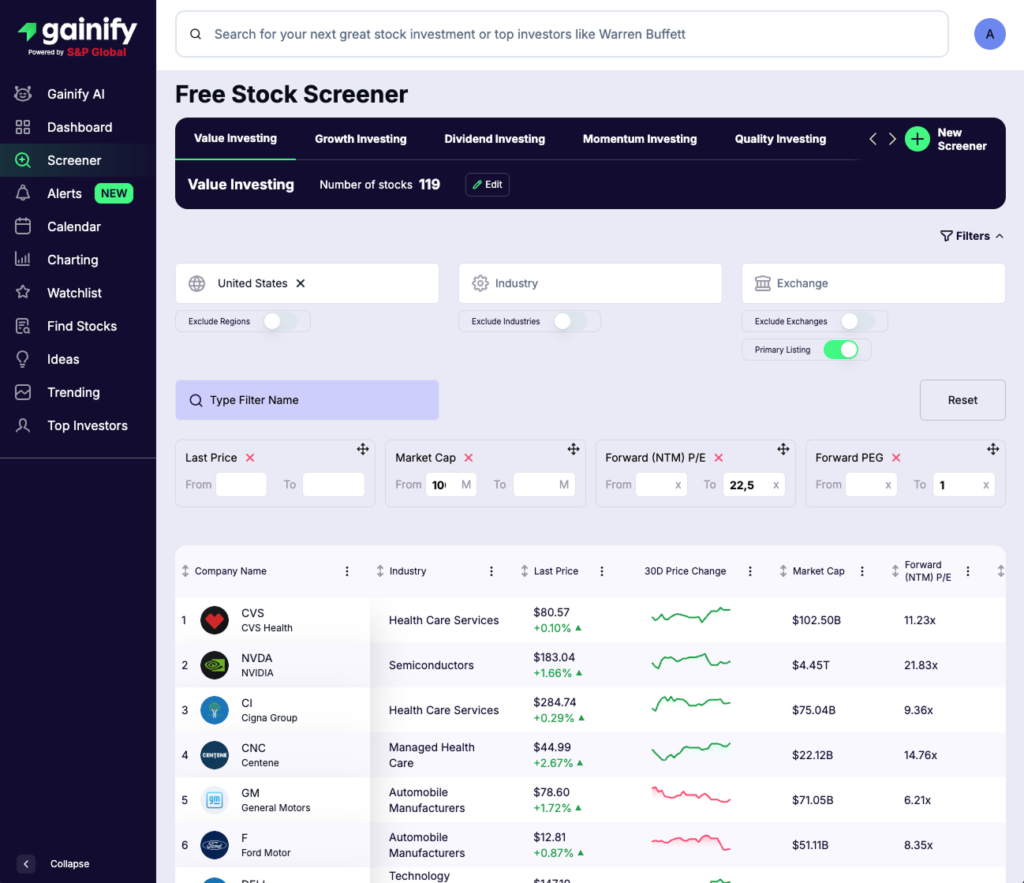
Most investors should evaluate a screener on three points:
- Coverage: the ability to screen broadly across the markets you invest in.
- Data depth: clean fundamentals, forward estimates, and enough history to judge trends.
- Ranking and workflow: the ability to sort, rank, save, and revisit screens without rebuilding them.
Stock screeners can generally be grouped into four main functional categories, depending on the type of data they analyze and the investment approach they are designed to support.
Screener type | Primary purpose | Typical users |
Fundamental screener | Analyze valuation, profitability, growth, and balance-sheet strength | Long-term investors |
Technical screener | Identify price trends, momentum, and trading signals | Traders |
Factor screener | Rank companies using factors such as value, quality, or momentum | Quantitative investors |
Hybrid screener | Combine fundamental and technical criteria | Active investors |
The appropriate type depends on the investment approach. Long-term investors typically rely on fundamental screeners to identify companies with strong financial performance and attractive valuations. Traders rely more heavily on technical screeners to identify liquid stocks with strong price action. Quantitative investors often use factor screeners that rank companies according to predefined investment factors.
Another practical decision is whether to use a free stock screener or a paid stock screener. A free stock screener typically provides core filtering functionality and standard financial metrics, which is often sufficient for straightforward strategies or initial idea generation. A paid stock screener usually offers broader datasets, forward estimates, deeper financial history, and more advanced ranking or customization tools.
Many investors begin with a free stock screener to develop their screening process and later transition to a paid stock screener once they require deeper data coverage or more advanced analytical capabilities.
2. Define your investment strategy
Before selecting filters, investors must first define the investment strategy they want the screener to support. A stock screener is only a tool for applying rules. The quality of the output depends entirely on the strategy behind those rules.
Different investment strategies focus on different financial characteristics. These characteristics determine which filters should be applied in the screener.
Strategy | Primary focus | Typical filters |
Value investing | Companies trading below intrinsic value | Low P/E, low PEG, high free cash flow yield |
Growth investing | Strong revenue and earnings expansion | Revenue growth, EPS growth, analyst estimate upward revisions |
Dividend investing | Stable income generation | Dividend yield, payout ratio, dividend growth |
Momentum investing | Strong price trends | Price performance, relative strength, trading volume |
Quality investing | High profitability and strong balance sheets | High return on capital, above average operating margins, low leverage |
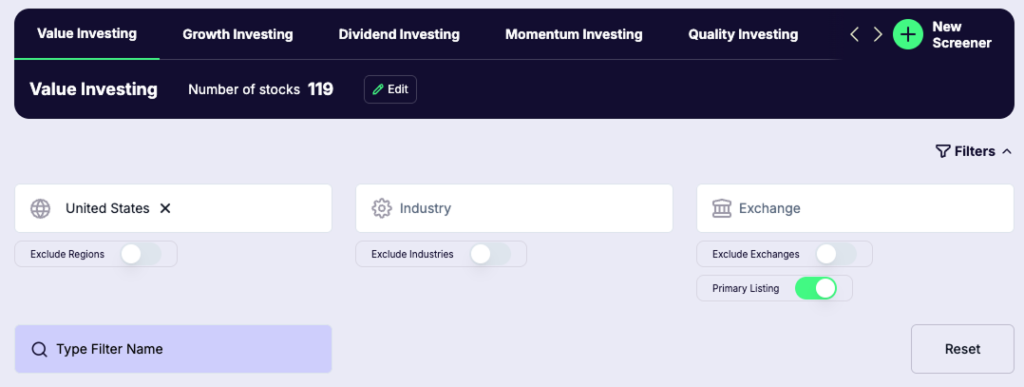
For example, a value investor may screen for companies with low price-to-earnings ratios, strong free cash flow, and conservative debt levels. A growth investor may instead prioritize revenue growth, earnings acceleration, and positive analyst revisions. Traders using a momentum strategy often focus on price performance, trading volume, and volatility indicators.
This approach is supported by decades of academic research. Studies such as the Fama–French asset pricing models and later factor research by institutions including AQR Capital Management show that certain company characteristics repeatedly appear among outperforming stocks. These characteristics, commonly called investment factors, include value, momentum, profitability, and low volatility.
Without a clearly defined approach, investors often combine unrelated metrics and end up with inconsistent screening results. For example, mixing deep value filters with aggressive growth criteria may eliminate most companies or produce a list that does not reflect a clear investment thesis.
To make the screening process effective, investors should start with one clearly defined strategy, then select a small set of financial metrics that best represent it. Limiting the number of filters to the most relevant indicators helps produce cleaner results and makes the screen easier to interpret and refine over time.
3. Select screening filters
Once the investment strategy is defined, the next step is selecting the screening filters that translate that strategy into measurable financial criteria. Filters determine which companies remain in the results and which are excluded from the investment universe.
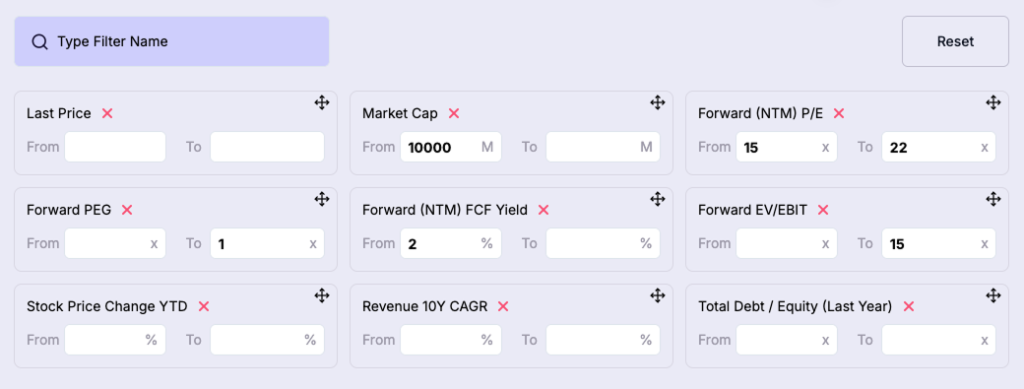
Most stock screeners organize metrics into logical groups that reflect different aspects of company analysis. These often include Income Statement, Balance Sheet, Cash Flow, Valuation, Estimates, and Market Data categories, alongside additional ratio-based metrics. Structuring filters this way allows investors to evaluate businesses from several perspectives within a single screening workflow.
For example, Income Statement filters focus on operating performance, including metrics such as revenue, operating income, or earnings growth. Balance Sheet metrics evaluate financial stability through measures such as leverage or debt levels. Cash Flow filters focus on how effectively profits translate into real cash generation, often using indicators such as operating cash flow or free cash flow.
Valuation metrics help investors compare price relative to fundamentals. Common examples include the price-to-earnings ratio (P/E), EV/EBITDA, PEG ratio, or free cash flow yield. In addition, some screeners allow investors to incorporate forward-looking data from analyst estimates, which helps identify companies expected to improve financially.
For example, a value-oriented screen may combine valuation measures such as P/E or EV/EBITDA with profitability indicators like return on capital to identify companies that appear inexpensive yet financially strong.
Aspect | Explanation |
Why this step matters | Filters determine the financial profile of the companies the screener will identify. When filters reflect the investment strategy, the results include companies with similar financial characteristics. |
What happens if skipped | If filters are selected without a clear connection to the strategy, the screener may produce companies that share few meaningful financial traits. This makes the results harder to interpret and reduces the effectiveness of the screening process. |
How to optimize it | The most effective screens rely on a small number of relevant metrics rather than many unrelated filters. Combining complementary indicators such as valuation and profitability or growth and financial strength usually produces clearer and more useful results. |
4. Set filter thresholds (minimum and maximum values)
After selecting the filters, the next step is defining thresholds for each metric. Thresholds specify the acceptable range for a financial indicator and determine which companies remain in the results. This step converts general ideas such as “cheap,” “profitable,” or “financially strong” into clear screening rules.
Value investors often set thresholds on valuation, profitability, and cash flow metrics to identify companies trading at reasonable prices relative to their fundamentals.
Example of a simple value-oriented screen
- P/E ratio: below 8x and 20x
- PEG ratio: below 1x
- Free cash flow yield: above 3%
- EV/EBITDA: below 20x
These values are not strict rules. They serve as starting points that investors adjust depending on sector characteristics, interest-rate conditions, and overall market valuations.
5. Generate and rank results
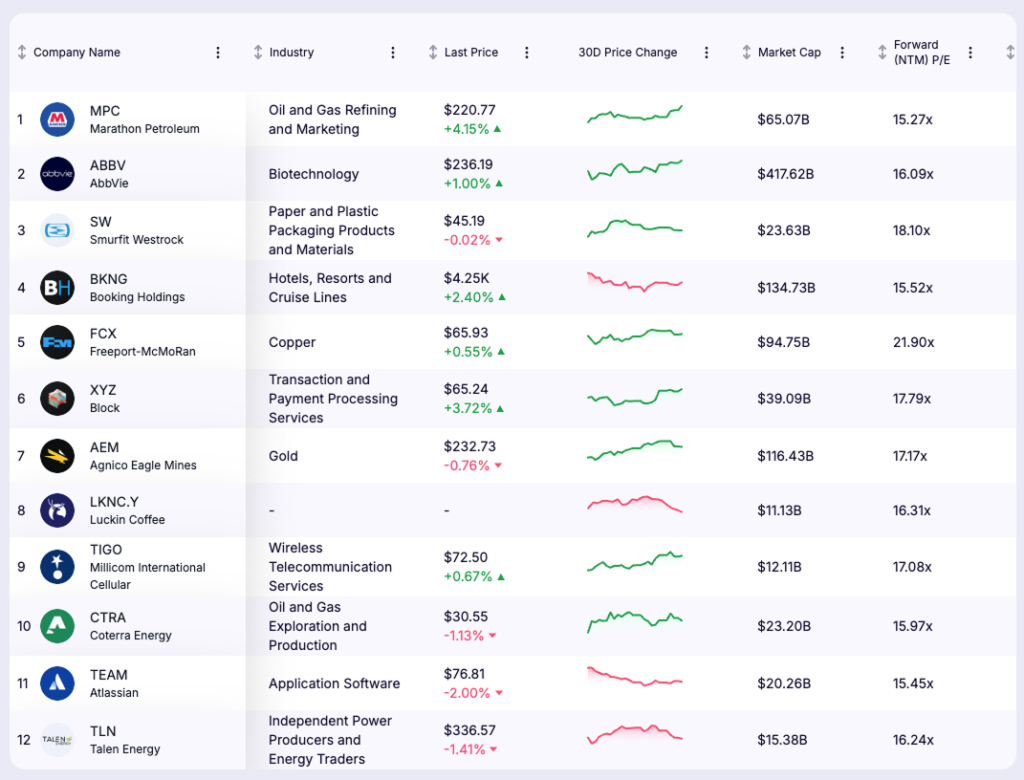
After applying filters, the screener returns a list of candidate stocks that meet the selected criteria. The next step is organizing those results so the most relevant companies appear first. This is typically done by sorting or ranking the results using the metric that best reflects the investment strategy.
For example:
- Value strategy: sort by the lowest EV/EBITDA or lowest P/E ratio
- Growth strategy: sort by the highest revenue growth (CAGR) or earnings growth (CAGR)
- Dividend strategy: sort by the highest dividend growth or dividend yield
- Momentum strategy: sort by the strongest recent price performance
Sorting helps investors focus their analysis on the most promising candidates rather than reviewing every company returned by the screener.
Most modern stock screeners also allow users to customize the output table by adding additional columns. This is important because different strategies require different information for comparison. For instance, a value investor may want to compare valuation multiples alongside profitability metrics, while a growth investor may prefer to see revenue growth, margin expansion, and analyst estimates in the results table.
Adding relevant columns allows investors to compare companies side by side without opening each profile individually. The ability to customize which metrics appear in the results table is therefore a key feature of effective screening tools, because it makes it easier to evaluate and prioritize stocks before moving to deeper analysis.
6. Analyze shortlisted stocks
After ranking the results, the next step is analyzing the shortlisted companies in more depth. A stock screener helps identify candidates, but it does not provide the full context required to make an investment decision. Each company must be reviewed to confirm that the underlying business supports the investment thesis.
At this stage, investors move beyond the basic screening metrics and examine both financial and qualitative factors. Financial review typically involves checking whether earnings quality, cash flow generation, and balance sheet structure are consistent with the screening results. Just as important are qualitative elements, such as the company’s competitive position, management quality, business model durability, and industry dynamics.
For example, two companies may appear similar based on valuation or growth metrics in the screener. A more detailed review may reveal that one company has stronger competitive advantages, more disciplined capital allocation, or operates in a more favorable industry structure.
Because this research often takes place over time, investors commonly save promising companies to a stock watchlist. A watchlist allows investors to track selected stocks, monitor developments such as earnings releases or guidance changes, and revisit potential opportunities as valuations evolve.
7. Review results and refine filters as the strategy evolves
Stock screening should not be a one-time exercise. Markets change, company fundamentals evolve, and investment strategies improve over time. For that reason, investors should regularly review the screening results and adjust filters when necessary.
After analyzing shortlisted companies, investors often discover patterns that help refine the screening process. For example, the initial screen may return too many companies with weak balance sheets, inconsistent earnings, or low liquidity. Adjusting filters can improve the quality of future results and make the screening process more efficient.
Refinement may involve tightening or relaxing certain thresholds, adding new filters that capture important characteristics, or removing filters that do not meaningfully improve the results. Over time, this iterative process helps investors build a screening framework that consistently produces relevant investment ideas.
Example of Stock Screening Strategies
Choosing a clear investment strategy is essential when using a stock screener. A screener simply applies rules to a database of companies. The usefulness of the results depends on whether those rules reflect a coherent investment approach. Without a defined strategy, filters become arbitrary and the results lose analytical value.
Professional investors typically design screens around established investment styles such as value, growth, dividend income, or momentum. These approaches focus on specific financial characteristics that have historically appeared among outperforming companies, such as attractive valuations, strong earnings expansion, reliable income generation, or persistent price trends.
Because of this, effective screening models usually rely on a small set of clearly defined factors rather than combining unrelated metrics. Below are several common screening strategies and the metrics typically used to implement them.
Value Investing Screen
A value investing screen focuses on companies trading below their estimated intrinsic value. The objective is to identify stocks where the market price appears low relative to earnings, cash flow, or assets.
Value investors typically look for companies with:
- Low price-to-earnings (P/E) ratios, often relative to their historical average or industry peers
- Low EV/EBITDA multiples, indicating the business may be undervalued compared with its operating earnings
- Low PEG ratios, suggesting the valuation is reasonable relative to expected growth
- High free cash flow yield, which signals strong cash generation relative to historical average
- Healthy return on capital, showing the company deploys capital efficiently relative to industry peers
- Positive analyst upside, where consensus price targets indicate potential appreciation
In many cases, these metrics are evaluated relative to the company’s own historical range or sector averages, rather than using absolute thresholds. This helps investors identify situations where the market may be temporarily undervaluing a fundamentally solid business.
Growth Investing Screen
A growth investing screen targets companies expanding faster than the broader market. Investors focus on businesses that demonstrate sustained increases in revenue, earnings, and market share, often supported by strong industry demand or competitive advantages.
Typical growth filters include:
- Revenue CAGR (last 3 years) showing consistent historical expansion
- Forward EPS growth projections based on analyst expectations
- Positive analyst revisions, signaling improving outlook
- Healthy operating margin trends, reflecting improving efficiency as the company scales
- Increasing market share within its industry
- High return on invested capital, indicating that growth is generated efficiently
Growth investors often accept higher valuation multiples when a company demonstrates durable growth potential and the ability to reinvest capital at attractive rates over time.
Dividend Investing Screen
A dividend investing screen focuses on companies that generate stable cash flows and distribute a meaningful portion of those profits to shareholders. The objective is to identify businesses capable of sustaining and gradually increasing dividend payments over time.
Typical dividend filters include:
- Dividend yield, identifying companies that provide meaningful income relative to share price
- Payout ratio, ensuring dividends are supported by earnings and not excessively high
- Dividend growth history, such as consistent increases over the past 3–5 years
- Free cash flow coverage, confirming that dividends are supported by cash generation
- Net debt to EBITDA or leverage ratios, assessing balance sheet sustainability
Income-focused investors typically prioritize companies with stable earnings, durable cash flows, and conservative leverage, which increases the likelihood that dividends can be maintained through economic cycles.
Momentum Strategy Screen
A momentum screening strategy identifies stocks with strong recent price trends. The approach is based on the empirical observation that securities demonstrating strong relative performance often continue outperforming over shorter time horizons.
Momentum screens commonly incorporate technical and market-based indicators, including:
- Price performance over the past 6–12 months, identifying strong recent winners
- Trading above key moving averages, such as the 50-day and 200-day moving averages
- Relative Strength Index (RSI) levels indicating sustained momentum
- Increasing trading volume, which can confirm price trends
Momentum strategies are widely used by active investors and traders seeking opportunities driven by market trends, earnings upgrades, or improving investor sentiment.
Common Mistakes When Using Stock Screeners
Stock screeners are powerful tools, but mistakes in the screening process can reduce their usefulness. Being aware of common pitfalls helps investors design more effective screening workflows.
Some of the most frequent mistakes include:
- Too many filters. Overly restrictive screens can remove strong companies and leave too few results.
- Random metrics. Filters that are not aligned with a clear investment strategy produce inconsistent results.
- Strict thresholds. Unrealistic limits may eliminate otherwise attractive opportunities.
- Ignoring qualitative factors. Elements such as management quality, competitive advantages, or industry structure still matter.
- Blind reliance. Assuming screened stocks are automatically good investments without further analysis.
- Outdated filters. Failing to update screens as market conditions and company fundamentals evolve.
- Historical bias. Relying only on past data while ignoring forward expectations.
A stock screener should be viewed as a starting point for research, not a replacement for proper analysis.
FAQ
How does stock screener work?
A stock screener works by filtering a database of publicly traded companies using predefined investment criteria. Investors narrow the universe using metrics related to valuation, earnings quality, growth dynamics, and market positioning. The screener then returns a list of stocks that meet those conditions.
Can stock screeners guarantee profits?
No. Stock screeners cannot guarantee profits. They only identify companies that meet specific financial criteria. Investment results ultimately depend on company performance, market conditions, entry price, and portfolio management decisions.
What are the benefits of using stock screener?
Stock screeners help investors analyze large numbers of companies quickly and apply consistent investment criteria. The main benefits include:
- Faster analysis across thousands of publicly traded stocks
- Ability to apply consistent financial filters across the entire market
- Discovery of new opportunities beyond well-known large-cap companies
- A more structured research process that turns stock selection into a repeatable workflow
- Easier comparison of companies using standardized financial metrics
What are the limitations of stock screener?
Stock screeners rely primarily on quantitative financial data. While they are effective at identifying companies that meet specific numerical criteria, they cannot evaluate qualitative factors such as management quality, competitive advantages, brand strength, regulatory risks, or industry dynamics.
For this reason, screening should be viewed as a first step in the research process. Investors still need to conduct additional analysis to understand the underlying business and confirm whether the company truly fits the investment thesis.
Are free stock screeners good enough?
A free stock screener is often sufficient for basic filtering and generating initial investment ideas. As investors develop more structured strategies, some transition to paid stock screeners, which offer broader datasets, longer financial histories, and more advanced ranking tools that support more precise screening workflows.
How to use stock screeners for beginners?
Beginners should start by applying a simple strategy and a small number of filters. Focus on a few widely used metrics to narrow thousands of stocks into a manageable shortlist, and then review those companies in more detail before making any investment decisions.
How often should I update my screen?
Investors should update their screens at least once per month to incorporate the latest financial data, analyst estimate revisions, and market movements. A practical approach is to refresh screens at the beginning of each month, for example on the first trading day, so that newly reported earnings, updated forecasts, and price changes are reflected in the screening results.
How to combine screening with fundamental analysis?
Stock screening identifies potential candidates, while fundamental analysis determines whether those companies are worth investing in. Investors typically start by using a screener to narrow thousands of stocks down to a shortlist based on metrics such as valuation, growth, or profitability. They then perform fundamental analysis to review financial statements, cash flow generation, balance sheet strength, and the company’s competitive position. In practice, screening generates investment ideas, while fundamental analysis confirms whether the underlying business supports the investment thesis.
What is the difference between a stock screener and stock scanner?
A stock screener filters companies based on financial metrics and predefined investment criteria. A stock scanner, on the other hand, tracks real-time market activity such as price movements, unusual trading volume, or short-term technical signals.
You can read a detailed explanation in in-depth comparison of stock screener and stock scanner.
 Jake McMahon