
8 Best Stock Screeners in 2026

Jake McMahon
Jake McMahon
Head of Growth
best stock screeners

The best stock screeners are decision tools that filter large equity universes using user-defined financial metrics, valuation criteria, or technical indicators. A stock screener allows investors to apply the same analytical framework across thousands of companies, narrowing the market to a shortlist of businesses that meet specific investment requirements. Used correctly, top stock screeners serve as the starting point of a structured investment process.

Choosing the right stock screener is not straightforward. Platforms vary widely in market coverage, financial metric depth, data accuracy, refresh frequency, and customization. Some are designed for technical traders who rely on price signals and indicators, while others support investors screening for revenue growth, free cash flow strength, returns on capital, and valuation discipline. Because of these structural differences, selecting the wrong platform can narrow your opportunity set and distort the companies that appear in your results. Comparing stock screeners is therefore essential, as the platform you choose ultimately shapes the output of your research.

In this article, I review the 8 best stock screeners in 2026 and compare them based on coverage, filter depth, data integrity, usability, and pricing. The objective is clear: help you choose the best stock screener app that strengthens your investment discipline and improves decision quality over time.

Best Stock Screener Comparison

Stock Screener
Rating
Best for
Strengths
Limitations
Market coverage
Price
Gainify
4.5/5
Global long term investors
1,000+ filters, forward estimates, AI screening, unlimited saved screens
AI usage caps, limited advanced technical indicators
85,000+ stocks, 153 exchanges, 95 countries
$9.92/month
TradingView
4.2/5
Technical & multi-asset traders
Direct screener-to-chart transition, global assets
Forward fundamentals limited, feature caps on lower tiers
150+ exchanges, stocks, crypto, forex, futures
$28.29/month
Finviz
3.8/5
Fast visual technical screening
Heat maps, rapid filtering, simple UI
Mostly US markets, no custom formulas, Trailing data focus
Primarily US
$24.96/month
Stock Rover
3.9/5
Deep fundamental investors
596 metrics, benchmarking vs S&P 500, strong financial history
US/Canada focus, dated UX
US & Canada
$17.99/month
Trade Ideas
2.6/5
Intraday momentum traders
Holly AI signals, real-time scanning, live trading rooms
Expensive, minimal fundamentals
US & Canada
$89.00/month
TC2000
3.8/5
Chart-focused traders & options users
EasyScan builder, formula logic, options scanning
Limited fundamentals, US/Canada only
US & Canada
$41.65/month
ZACKS
4.1/5
Rank-based stock selection
Proprietary Zacks Rank, analyst research
Limited customization, mainly US
Primarily US
$20.10/month
TIKR
4.4/5
Global fundamental data screening
700+ metrics, forward estimates, long financial history
UX below average, limited saved screens (Plus)
100,000+ stocks, 90+ countries
$17.95/month

The table compares eight best stock screening platforms across rating, ideal use case, structural strengths, constraints, coverage, and pricing. Each stock screener serves a distinct type of investor and reflects a different research philosophy.

My analysis shows that some platforms prioritize technical analysis and active trading (TradingView, TC2000, Trade Ideas). Others emphasize fundamental depth and financial benchmarking (Gainify, TIKR). Finviz focuses on speed and visual market orientation, while ZACKS centers around a proprietary ranking framework rather than flexible multi-factor construction.

The main structural differences across best stock screener apps fall into three categories:

  1. Data depth and forward metrics – Not all tools support forward earnings, analyst revisions, or multi-year projections.
  2. Market coverage – Coverage ranges from US-only datasets to global equity universes across 90+ countries.
  3. Workflow flexibility – Saved screen limits, column customization, AI integration, and automation vary meaningfully.

If your investment process relies on global market access, forward-looking data, and structured multi-factor screening, it is worth testing how a modern stock screener can support structured research in practice.

1. Gainify

best stock screeners - gainify.io - rating

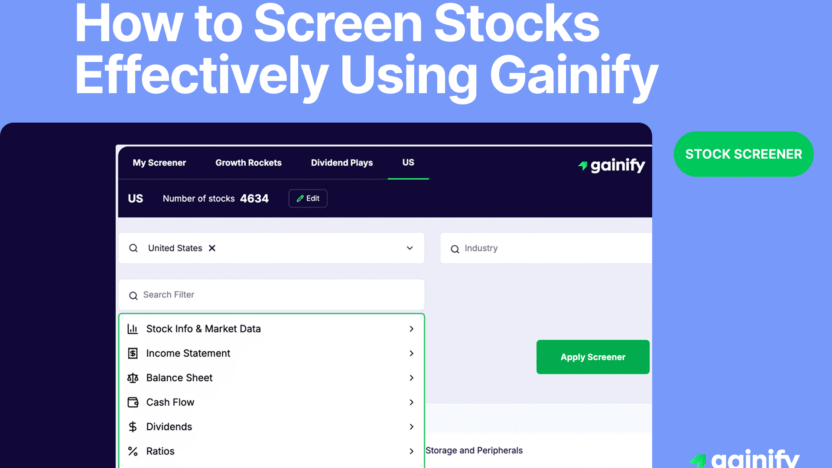
Gainify is a global multi-factor stock screener built for investors who want to search the entire equity market with highly customizable financial filters. The platform covers 85,000+ stocks across 153 exchanges in 95 countries, supported by institutional datasets from providers such as S&P Global Market Intelligence, refreshed multiple times daily. Gainify stands out for combining global coverage with a level of screening flexibility typically found only in institutional research platforms.

The platform’s defining strength is its extreme customization. Gainify provides 1,000+ screening parameters and more than 1,000 customizable result columns, allowing investors to construct sophisticated screeners. It also includes an AI-powered stock screener that converts natural-language descriptions of a strategy or company profile into structured screening logic, making complex screens fast to build and easy to refine.

When I tested the platform, I focused on building complete investment workflows rather than simple filters. I created forward-looking growth screens, valuation compression models, and global quality filters across multiple sectors. Screening, shortlisting, and monitoring companies remained connected inside the same research environment, allowing ideas to move directly from discovery to watchlists. This combination of deep customization, AI-assisted screening, and uninterrupted research workflow makes Gainify one of the top stock screeners available today, especially considering its price point.

Best for

Gainify is built for investors who treat screening as the foundation of a disciplined investment process rather than a quick idea generator.

The best stock market software I have ever used. I love the stock screener, the AI, and the valuation charts. Super nice to compare P/E ratios with other stocks and peers.

– Gainify user, review posted on Trustpilot

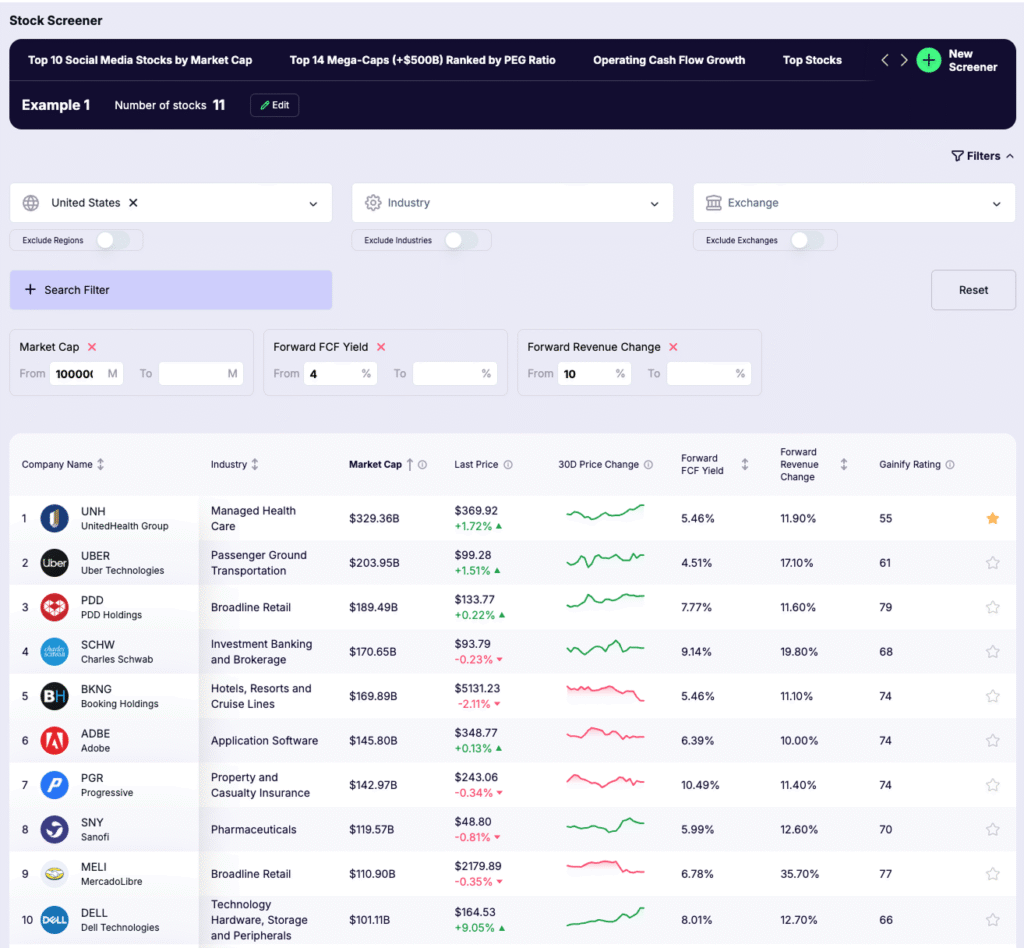
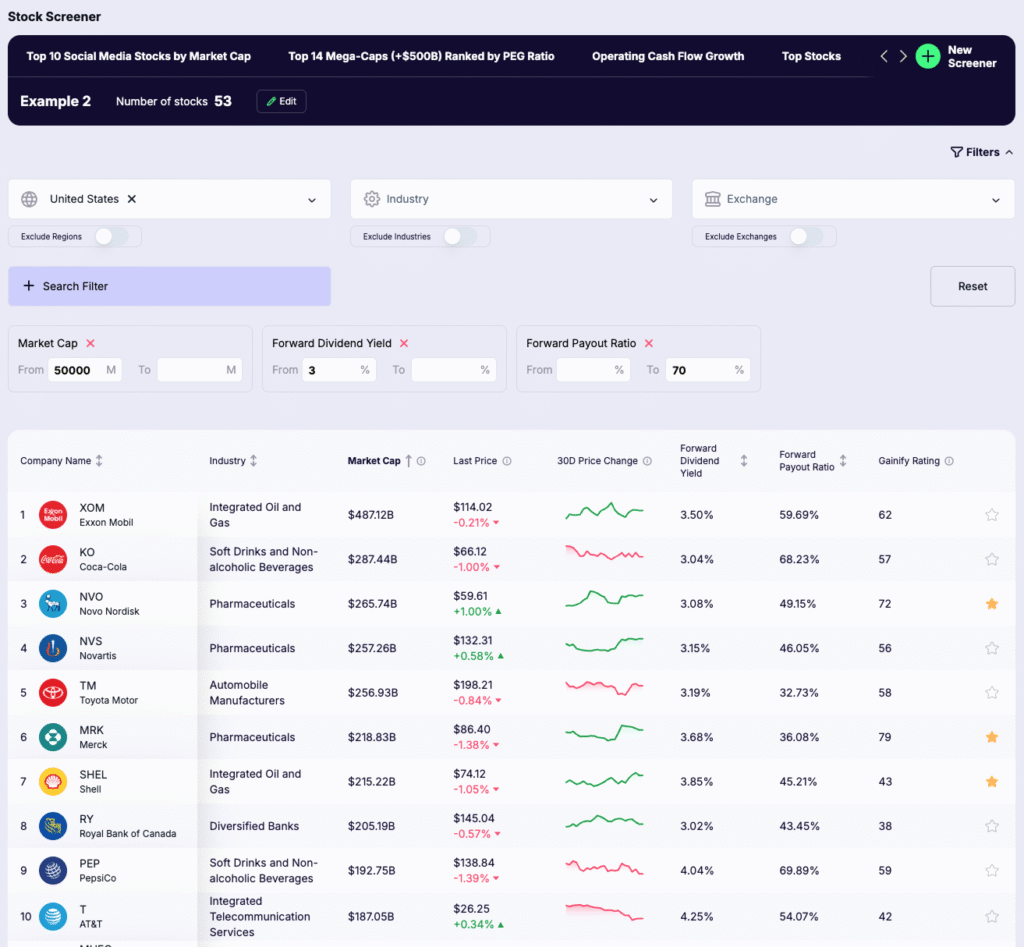
It is particularly well suited for:

  • Global equity investors who require unrestricted access across developed and emerging markets
  • Expectation-focused investors who base decisions on forward earnings, revenue trajectories, and revision momentum instead of backward-only financials
  • Multi-factor portfolio builders combining valuation, growth, profitability, quality, and risk metrics in one structured model
  • Systematic investors who need unlimited saved screens and repeatable workflows
  • AI-augmented researchers looking to accelerate complex screen construction without losing metric-level control

Gainify is less focused on short-term intraday trading or purely chart-based strategies. It is designed for investors who prioritize data depth, forward visibility, and scalable research logic.

best stock screeners - gainify

Strengths

Gainify’s advantages concentrate around three structural pillars: data depth, global scale, and workflow flexibility.

  • Institutional-grade data powered by sources such as S&P Global Market Intelligence, refreshed multiple times daily
  • Global universe coverage of 85,000+ equities across 153 exchanges and 95 countries, including secondary listings
  • 1,000+ screening parameters spanning fundamentals, valuation, forward estimates, technicals, quality, and risk
  • 1,000+ customizable output columns allowing fully tailored multi-factor result views
  • Unlimited saved screens enabling disciplined model iteration and strategy tracking
  • AI-powered discovery tools, including AI stock analysis, that translate natural-language investment ideas into structured screening logic
  • Always-current data updates 4 times per day
  • Integrated research workflow that lets investors transfer screened companies directly into analysis and monitoring using a built-in stock watchlist

The platform’s core strength is structural consistency. It allows investors to design screening logic around their process rather than adapting their process to platform limits.

Limitations

Despite its depth and global flexibility, a few structural constraints remain.

  • Limited technical indicator set compared to chart-first platforms such as TradingView, making it less suited for advanced intraday or pattern-based trading
  • No broker integration, so trade execution must occur externally
  • AI usage caps depending on subscription tier
  • Advanced automation layers reserved for higher plans

These limitations mainly impact traders who rely on complex technical indicator stacks or high-frequency automation. Gainify is positioned around forward-looking fundamentals, multi-factor modeling, and global screening depth rather than advanced chart-based or intraday execution workflows.

Pricing

Gainify offers a simple, value-oriented pricing structure with plans that scale in capability rather than locking core functionality behind high paywalls.

Plan
Price
Key Access
Starter
$0
500+ screening parameters, global coverage, unlimited saved screens
Investor
$9.92/month
1,000+ screening parameters, 1,000+ custom output columns, expanded AI usage
Gainer Pro
$26.99/month
Maximum AI limits, priority support, full extended research tools

Compared to traditional premium screeners that charge $20-$100+/month for similar data depth and global scope, Gainify delivers institutional-grade screening and AI-enhanced workflows at one of the strongest price-to-capability ratios currently available.

2. TradingView

best stock screeners - tradingview - rating

TradingView is a market analysis platform that combines stock screeners with an advanced charting environment, allowing users to discover and analyze trading opportunities within a single system. TradingView’s screener is tightly integrated into its charting ecosystem, making it possible to move directly from filtered assets to interactive price charts.

After testing the paid tiers with a focus on screening functionality, it is clear that TradingView is built around technical analysis first, with global breadth as its second major advantage. The workflow from screener to interactive chart is immediate. You can filter assets, open charts, adjust timeframes, and apply indicators without switching platforms.

Unlike many U.S.-centric tools, TradingView covers 150+ exchanges across more than 50 countries. Screening spans stocks, ETFs, crypto, futures, forex, and derivatives. That breadth makes it one of the most globally accessible stock screening apps available. However, financial metrics are primarily backward-looking. Forward analyst estimates and intrinsic valuation modeling require external tools or higher-tier plans.

Best for

TradingView is structured for traders who think in charts and operate across multiple markets. Its screener performs best when technical context and global asset access matter more than deep financial modeling.

  • Indicator-driven traders using RSI, moving averages, volatility bands, and pattern setups
  • International investors screening equities across 150+ exchanges, not just U.S. markets
  • Multi-asset participants filtering stocks, ETFs, crypto, futures, and forex within a single interface
  • Integrated workflows where screening immediately transitions into chart analysis without switching tools

It is less appropriate for investors focused on forward earnings modeling, discounted cash flow analysis, or complex multi-factor fundamental strategies.

best stock screeners - TradingView

Strengths

TradingView’s advantage lies in workflow integration and market coverage.

  • Direct screener-to-chart transition enabling immediate visual validation of filtered results
  • Extensive global coverage spanning more than 150 exchanges
  • 200+ screening fields combining technical indicators and core financial metrics
  • Flexible column customization aligning filters with output views
  • Cross-asset screening capability across equities, crypto, forex, and derivatives
  • Pine Script functionality supporting custom indicators and proprietary strategy logic
  • Large user community contributing shared scripts and technical ideas

For technically focused traders working across international markets, TradingView provides one of the most cohesive and scalable screening environments available.

Limitations

TradingView offers exceptional breadth and chart integration, but its structure is clearly optimized for technical workflows rather than deep financial modeling.

  • Historical data focus with most financial metrics backward-looking and limited forward valuation support
  • Fundamental depth constraints, as financial metrics are not as granular as dedicated fundamental platforms
  • Screener automation limits, with advanced auto-refresh and large-scale alert logic scaling only in higher tiers
  • Indicator stacking constraints, even on paid plans compared to specialized quantitative platforms
  • Primarily chart-first design, which can make multi-factor financial modeling less efficient

For traders centered on price action and multi-asset access, these constraints are manageable. For investors seeking automated multi-factor screening or forward-looking valuation frameworks, additional tools are required.

Pricing

TradingView structures its plans across one free tier and four paid subscriptions, with each upgrade expanding alert capacity, historical depth, and chart flexibility rather than fundamentally altering the screener itself.

Plan
Price (Monthly, billed annually)
Key Screener & Chart Impact
Free
€0
Delayed data, 2 indicators per chart, limited alerts, ads
Essential
€12.95/month
Increased indicators, more alerts, expanded historical bars
Plus
€28.29/month
Higher alert limits, more charts per tab, deeper history
Premium
€56.49/month
Substantially expanded alerts, multi-chart layouts, extended bar history
Ultimate
€199.95/month
Maximum alert capacity, highest historical limits, priority support

Upgrading primarily enhances execution capacity: more indicators per chart, more simultaneous charts, greater historical bar limits, and significantly higher alert thresholds. The core screening database remains largely consistent across tiers, with paid plans improving speed, scale, and automation rather than adding new fundamental depth.

3. Finviz

best stock screeners - finviz - rating

Finviz is a browser-based stock screener and market visualization platform designed for rapid scanning of the equity market. It has been an industry standard for nearly two decades and was among the first widely adopted web-based screeners. Its design philosophy emphasizes speed, clarity, and visual market orientation, making it particularly useful for quickly identifying trading opportunities.

After testing both the free screener and reviewing Elite features, it becomes clear that Finviz prioritizes fast market scanning over deep financial modeling. The platform is largely U.S.-focused, with filters loading instantly and lightweight charts that allow users to move quickly between ideas. The interface feels dated compared to modern platforms, but its simplicity and speed remain key advantages.

One of Finviz’s defining features is its market heat map, which provides an immediate sector-level view of market performance and leadership. The free screener includes under 100 predefined filters across valuation, financial ratios, and technical indicators, with mostly trailing data. Finviz Elite expands functionality with roughly 200 metrics, real-time data, ETF screening, backtesting tools, and export capabilities.

Best for

Finviz is built for speed and market orientation. It works best when the objective is to identify setups quickly rather than conduct detailed financial modeling.

  • Short-term technical traders scanning RSI levels, moving average crossovers, chart patterns, and breakout structures
  • Momentum-focused users identifying sector rotation and relative strength through heat maps
  • Visually driven investors who prefer performance grids and color-coded views over data tables
  • Traders seeking instant access to a free screener without account registration

It is not structured for forward-looking earnings modeling, intrinsic value estimation, or multi-year fundamental trend analysis.

best stock screeners - Finviz

Strengths

Finviz stands out for efficiency and visual clarity.

  • Market-leading heat map visualization for rapid sector and index performance assessment
  • High-speed filtering engine with immediate result refresh
  • Extensive predefined technical pattern filters for momentum and breakout strategies
  • ETF filtering and enhanced statistics view in Elite
  • Approximately 200 filters in Elite, significantly expanding screening flexibility
  • Real-time pricing in Elite, compared to a 15 min delay in the free screener
  • Integrated news headlines directly within screener results

Finviz remains one of the most efficient platforms for fast technical screening and broad market scanning.

Limitations

Finviz’s streamlined structure keeps it fast, but several analytical constraints remain:

  • Limited filters with fewer than 200 predefined options in the Elite plan
  • No custom formulas or user-defined metric construction
  • Trailing data focus with financials primarily backward-looking
  • No forward estimates available in both free and Elite versions
  • U.S.-only coverage without international equities
  • Outdated interface with minimal workflow customization

Even in the Elite tier, the platform remains optimized for rapid technical filtering rather than comprehensive fundamental research.

Pricing

Finviz provides two subscription tiers depending on how much data access and filtering you need:

Plan
Price
Key Access
Free
$0
Delayed pricing, basic filters (<100), heat map visualization
Elite
$24.96/month
Real-time data, ~200 filters, ETF filters, statistics view, backtesting, export

The free version is already highly usable for quick technical screening and visual market orientation, while Elite primarily enhances data timeliness, expands filter options, and adds export and advanced analysis tools.

4. Stock Rover

best stock screeners - stockrover - rating

After spending time working through Stock Rover’s Premium tiers, it became clear that this is a platform built for investors who care about financial statement depth rather than trading signals. The interface feels dated and somewhat dense, and navigation is not particularly intuitive. However, beneath that older design sits one of the more comprehensive fundamental screening databases available for North American equities.

Stock Rover focuses almost entirely on financial analysis. It offers access to roughly 596 fundamental metrics, covering profitability, growth, valuation, leverage, dividend safety, and capital efficiency. You can screen using detailed timeframes, including specific fiscal quarters, calendar years, trailing twelve months, and historical periods extending back up to 10 years. That flexibility makes it possible to analyze trend durability rather than relying on a single snapshot.

The platform also includes strong benchmarking tools. You can compare a company directly against its industry, sector, and the S&P 500. Valuation analysis is primarily backward-looking, based on historical multiples rather than forward intrinsic value modeling, but the relative comparison framework is well implemented.

Best for

Stock Rover is structured for investors who base decisions on financial statements and multi-year trend analysis rather than short-term price action.

  • Long-term fundamental investors evaluating revenue durability, margin expansion, and return on capital over full cycles
  • Data-driven screen builders who want access to hundreds of accounting-based filters
  • Dividend-focused strategies analyzing payout ratios, forward income projections, and balance sheet coverage
  • Relative valuation users comparing companies against industry peers, sector averages, and the S&P 500

It is not built for short-term trading, technical breakout scanning, or momentum-driven workflows.

best stock screeners - Stock Rover

Strengths

Stock Rover’s advantage lies in financial depth and structured comparative analysis.

  • 596 fundamental metrics covering profitability, valuation, growth, leverage, capital efficiency, and cash flow
  • Flexible historical timeframe selection, including quarterly, calendar year, and TTM views extending up to 10 years
  • Integrated benchmarking tools versus industry, sector, and S&P 500
  • 140 pre-built screeners available, and custom screening is enhanced by a huge range (600+) of filtering criteria
  • Analyst estimate integration in paid tiers for forward-looking screening
  • Customizable result columns, improving output control despite the rigid interface

The platform is strongest when used to evaluate financial trend consistency and comparative valuation across defined time horizons.

Limitations

While financially robust, the platform has structural trade-offs.

  • US and Canadian market focus, limiting global stock coverage
  • Below-average user interface, with a dense and somewhat outdated layout
  • Full screening locked behind paid plans
  • Valuation tools primarily backward-looking, with limited intrinsic value modeling
  • Learning curve due to data density and navigation complexity

Stock Rover offers substantial analytical power, but extracting full value requires time and familiarity with the interface.

Pricing

Stock Rover structures its offering across four progressively expanded subscription tiers, with full screening functionality reserved for paid plans.

Plan
Price
Key Access
Free
$0
Limited research tools, no full screener access
Essentials
$7.99/month
Core screening, 5-year financial history
Premium
$17.99/month
10-year financial history, advanced screening, data export
Premium Plus
$27.99/month
Full metric library, advanced portfolio analytics, research reports

The screener becomes meaningfully functional starting with the Essentials plan. Premium and Premium Plus extend historical depth, integrate analyst estimates, and unlock the complete metric database. Relative to the financial data coverage offered, pricing remains competitive within the fundamental analysis category.

5. Trade Ideas

best stock screeners - tradeideas - rating

Trade Ideas is a real-time stock scanning platform designed for active and intraday traders who rely on technical signals and automated trade identification. The system focuses on detecting short-term opportunities through price momentum, volume expansion, volatility shifts, and pattern-based triggers rather than traditional fundamental analysis.

After evaluating the paid tiers, it becomes clear that the platform is engineered for speed and intraday market monitoring. The interface feels dated and visually crowded compared to modern platforms, and overall usability is below current industry standards. However, the underlying scanning infrastructure is purpose-built for fast technical signal detection in active trading environments.

A defining component of the platform is Holly AI, which runs dozens of proprietary intraday strategies simultaneously. The engine typically generates between 5 and 25 trade ideas per day, each including predefined entry, stop-loss, and exit parameters based on short-term technical patterns and statistical modeling.

Best for

Trade Ideas is built for traders who operate inside the trading session, not outside it. It fits best when the objective is to identify short-term opportunity as it develops rather than to evaluate long-term business quality.

  • High-frequency day traders tracking intraday momentum, volatility expansion, and liquidity shifts
  • Breakout and continuation traders relying on price and volume confirmation
  • System-driven traders who prefer pre-structured AI trade setups over manual screen building
  • Technical-only operators who do not require income statement, cash flow, or valuation depth

It does not serve long-term fundamental investors or capital allocators focused on multi-year financial trends.

best stock screeners - Trade Ideas

Strengths

The value of Trade Ideas lies in signal production and intraday responsiveness.

  • Holly AI engine generating 5–25 daily trade setups with quantified entry, stop, and exit levels
  • Continuous real-time scanning designed to surface emerging technical patterns as they form
  • Relative performance ranking tools that visually prioritize momentum leadership during the session
  • Broad technical indicator set of roughly 100 indicators across paid tiers
  • Advanced alert automation enabling rule-based monitoring without manual refresh
  • Integrated paper trading module for live strategy simulation
  • Live trading room access (8:00am–3:30pm ET) offering real-time commentary and strategy discussion

Trade Ideas functions primarily as a live tactical execution platform. Its strength is immediacy, not analytical depth.

Limitations

The specialization toward short-term technical trading introduces clear constraints.

  • Minimal fundamental dataset, limiting valuation or financial quality screening
  • No robust free screener, with core functionality restricted to paid plans
  • Dated and visually dense interface, reducing workflow efficiency
  • US market focus only, restricting international coverage
  • High subscription cost relative to feature scope
  • Limited flexibility outside predefined technical workflows

The platform performs within its niche but does not provide the structural depth required for broader equity research.

Pricing

Trade Ideas structures its offering across three subscription tiers, with meaningful functionality unlocked only in the paid plans.

Plan
Price
Key Access
The Tester
$0
Delayed data, limited technical functionality
The Blue Bundle (Basic)
$89/month (annual billing)
Real-time data, charting, scanning, alerts
The Powder Elite (Premium)
$178/month (annual billing)
Holly AI signals, backtesting, advanced strategy tools

Full access to Holly AI and advanced AI-driven trade execution tools is restricted to the Premium tier. The pricing reflects its positioning as a specialized, intraday trading platform built for active market participants rather than broad investment research.

6. TC2000

best stock screeners - TC - rating

TC2000 is a charting and technical screening platform designed for traders who rely on rule-based technical signals and real-time filtering. The platform combines charting, watchlists, and a configurable scanning engine within a single workspace, but most advanced screening functionality is available only on paid tiers.

After testing TC2000 Premium with a focus on its screening and sorting capabilities, it becomes clear that the platform is built primarily for technically driven workflows. The interface reflects an older terminal-style design and navigation can feel dense compared to newer research platforms. The system itself is stable, but the user experience is less intuitive than many modern screening tools.

The core of the platform is EasyScan, TC2000’s rule-based screening engine. Screens are built from a blank workspace where conditions are added sequentially, with support for AND/OR logic and custom formulas written directly in the scan builder. This allows for highly granular technical rule construction, though fundamental screening depth and financial metric coverage remain limited compared with broader equity research platforms.

Best for

TC2000 Premium is best suited for traders who require detailed technical logic and structured rule building.

  • Advanced technical analysts constructing multi-condition indicator screens
  • Active traders relying on real-time scanning and sorting
  • Options traders incorporating options data into scan logic
  • Formula-oriented users comfortable building logical branches and custom conditions
best stock screeners - TC2000

It is not designed for global investors or valuation-driven fundamental screening.

Strengths

The value of the Premium tier is concentrated in technical control and scan precision.

  • EasyScan blank-canvas builder enabling full rule customization
  • AND/OR branching logic for complex condition structures
  • Custom formula writing directly inside the scan engine
  • Extensive technical indicator library covering major trend, momentum, and volatility metrics
  • Real-time scanning and sorting functionality
  • Options data integration for derivative-based filtering
  • Paper trading simulator for strategy testing

For technically disciplined traders, the platform provides structured flexibility and granular control.

Limitations

Despite strong technical depth, structural constraints reduce broader versatility.

  • Limited fundamental data, with shallow financial metric coverage
  • US-only equity universe, approximately 6,900 stocks
  • Outdated user interface, dense and less intuitive
  • Slow onboarding process, including signup and initial setup
  • Most core screening tools locked behind paid tiers
  • No broker integration
  • No advanced historical backtesting engine comparable to specialized platforms

These constraints make TC2000 specialized for technical trading rather than a comprehensive stock research environment.

Pricing

TC2000 structures its offering across three primary subscription tiers, with functionality expanding meaningfully at each level. The real value for active traders begins at the Premium tier, where full scanning and sorting capabilities are unlocked.

Plan
Price (Monthly Equivalent)
Key Access
Basic
$20.82/month
Real-time US data feed, stock & option charting
Premium
$41.65/month
EasyScan screening, real-time scanning & sorting, formula builder, alerts
Premium Plus
$83.32/month
Expanded alerts, additional advanced technical features

TC2000 does not offer a fully functional free plan. Access to screening tools, real-time scanning, and advanced condition building requires a paid subscription, with the Premium tier serving as the practical entry point for serious technical screening.

7. ZACKS

best stock screeners - ZACKS - rating

Zacks is a fundamental stock research platform built around its proprietary earnings estimate and ranking system. Its screening framework focuses on identifying stocks with improving earnings expectations and favorable analyst revisions rather than enabling complex multi-factor modeling.

I have carefully tested the Premium version of ZACKS and realized it is best suited for rank-driven investing rather than deep financial modeling. ZACKS is a stock screener built around its proprietary scoring system. Its core strength is the Zacks Rank and related factor scores. The Premium plan is where the platform becomes fully usable. It unlocks access to the complete Zacks Rank list, more than 45 premium predefined screens, and the Value, Growth, Momentum, and VGM composite scores.

Instead of building complex multi-layer filters, you screen using standardized scores. You can run screens, save results, export data, and add stocks to a portfolio tracker. However, the screener includes roughly 150 metrics, column customization is limited, and the interface feels static compared to more modern platforms.

Best for

The Premium plan is best suited for investors who prefer structured ranking systems over detailed financial screening.

  • Earnings revision investors who rely on analyst estimate upgrades
  • Factor-based strategies built around Value, Growth, Momentum, and VGM scores
  • Predefined screen users selecting from curated ranking strategies
  • US-focused portfolios given coverage of approximately 6,750 companies

Because the system revolves around scoring rather than extensive customization, it works best for focused, clearly defined approaches.

best stock screeners - ZACKS

Strengths

The value of ZACKS Premium lies in its proprietary ranking framework.

  • Zacks Rank system directly integrated into screening logic
  • Proprietary factor scores including Value, Growth, Momentum, and VGM composite
  • 45+ premium predefined screens aligned with internal ranking methodology
  • Access to #1 Rank list of roughly 220 Strong Buy stocks
  • Integrated research reports available from screening results

The platform simplifies stock selection by translating earnings momentum into standardized scores.

Limitations

While the scoring framework is clear, flexibility is limited.

  • Approximately 150 screening metrics, restricting deep customization
  • Coverage of around 6,750 companies, mostly US and Canada
  • Limited column customization within screener results
  • Static and dated interface compared to modern platforms
  • Minimal automation features for dynamic rule-based alerts

These constraints reduce scalability for advanced multi-factor strategies.

Pricing

ZACKS offers several subscription tiers depending on how much research access and portfolio strategy exposure you want.

Plan
Price
Key Access
Free
$0
Basic custom screener (150 metrics), limited data access
Premium
$249/year
45+ premium screens, full Zacks Rank list (~220 Strong Buy stocks), proprietary factor scores, detailed equity research reports
Investor Collection
$59/month or $495/year
Access to multiple long-term investor services (Value Investor, Income Investor, ETF Investor, Top 10 Stocks, and more)
Ultimate
$299/month or $2,995/year
Full access to nearly all ZACKS recommendation services, including specialized trading and thematic strategies

The Free plan provides limited screening functionality. Premium unlocks the full Rank-based screening system and research tools. Investor Collection and Ultimate are bundled research memberships focused on model portfolios and trade alerts rather than expanded screening capabilities.

ZACKS frequently offers promotional trial periods (such as discounted first-month access), but standard access is subscription-based.

8. TIKR

best stock screeners - TIKR - rating

TIKR is a global equity research and stock screening platform focused on financial statement analysis and analyst estimates. It allows investors to filter companies using detailed accounting data, valuation metrics, and forward forecasts across international markets, making it particularly suited for fundamentals-driven research.

When I use TIKR, I use it for one reason: financial depth. The Plus plan is the tier where the platform becomes genuinely useful for structured research. It gives me access to more than 100,000 stocks across over 90 countries and allows screening through a database of more than 700 financial metrics. That combination makes it practical for global, fundamentals-driven investing.

The platform is built around historical financial statements and forward analyst estimates rather than technical indicators. With the Plus plan, I can screen for multi-year revenue trends, margin progression, capital efficiency, and valuation across international markets in a single workflow. The strength of the plan is not presentation or speed. It is data breadth.

Best for

The Plus plan is best suited for investors who rely on structured financial analysis and are comfortable working with a focused number of screening strategies.

  • Global fundamental investors screening companies beyond US markets
  • Valuation-driven strategies comparing current multiples against multi-year financial history
  • Forward-looking research requiring both historical financial statements and analyst estimates
  • Focused workflows only given the limit of 5 saved screens, which supports disciplined screening but restricts running many parallel strategies
best stock screeners - TIKR

Strengths

The core advantage of the Plus plan lies in the depth and breadth of its screening database.

  • 700+ screening metrics allowing detailed filtering across profitability, growth, leverage, capital efficiency, and valuation
  • Global market coverage across 90+ countries, enabling international stock screening in one system
  • 10-year financial history supporting multi-year trend screens for revenue, margins, and returns
  • Forward estimate filters enabling screens based on expected revenue and earnings growth
  • Comprehensive financial statements integrated directly into screening logic rather than summary ratios only
  • Structured fundamental templates providing ready-to-use valuation and quality screens

The strength of the Plus plan is precision. It allows you to build fundamentally driven screens across a global universe using both backward-looking financial data and forward expectations.

Limitations

Despite strong screening depth, several structural constraints affect flexibility and workflow:

  • 5 saved screens only, limiting the ability to run multiple parallel strategies
  • Limited column customization, reducing control over how screening results are displayed
  • Basic interface design, which can slow navigation compared to more intuitive platforms
  • Pro-tier feature gating, with advanced transcript search and premium metrics restricted to higher plans
  • No workflow automation, meaning alerts and rule-based monitoring are limited

These limitations do not affect data breadth, but they reduce screening scalability and customization flexibility for more advanced users.

Pricing

TIKR offers three pricing tiers depending on the depth of access required.

Plan
Price
Key Access
Free
$0
US-only coverage, 3-year financial history, 1 saved screen
Plus
$19.95/month
Global coverage (90+ countries), 10-year financial history, 2-year forward estimates, 5 saved screens
Pro
$39.95/month
20-year financial history, 30 saved screens, transcript search, premium metrics

TIKR provides a permanent Free plan with limited functionality. The Plus and Pro plans can be tested risk free through a 14-day money-back guarantee.

The Importance of Stock Screeners

Stock screeners are essential tools for analyzing modern equity markets because they allow investors to filter thousands of publicly traded companies using predefined financial and valuation criteria. Instead of manually reviewing individual companies, investors can apply structured filters that convert a large equity universe into a focused set of investment candidates.

This capability is critical because equity markets generate continuous information updates. Companies publish new financial results every quarter, analyst estimates change frequently, and market valuations adjust in real time as new information is incorporated into prices. Without a systematic filtering framework, stock selection often becomes selective, inconsistent, and heavily influenced by narrative momentum.

A stock screener imposes order on this complexity by converting stock discovery into a rules-based process. Instead of starting with stories and searching for supporting evidence, investors begin with measurable financial standards and allow qualifying companies to emerge from the data.

My testing shows that four factors make stock screeners essential for serious investors:

1. Structural consistency

Long-term performance depends on repeatable decision-making. A screener forces you to define what qualifies as investable before reviewing individual stories. You establish measurable standards around revenue durability, margin progression, return on invested capital, balance sheet strength, and valuation discipline.

Every company is evaluated against the same analytical framework. This consistency reduces emotional bias, improves comparability across companies, and strengthens analytical discipline.

2. Full-universe coverage

Opportunity is often found outside the most visible names. A stock screener allows you to analyze thousands of companies across sectors, geographies, and market capitalizations simultaneously.

Instead of limiting research to large-cap benchmarks or trending industries, you can identify improving fundamentals or valuation dislocations wherever they occur. This broad coverage increases the probability of uncovering inefficiencies.

3. Valuation discipline and capital efficiency

Markets frequently misprice growth expectations, cyclicality, or temporary setbacks. A screener enables systematic identification of companies trading below historical valuation ranges, below peer multiples, or below internal intrinsic value assumptions. This structure is critical when finding undervalued stocks in large datasets.

By applying predefined valuation filters, investors can direct research toward companies where market prices diverge from underlying fundamentals. This structure improves capital efficiency by focusing analytical effort on statistically relevant candidates.

4. Managing constantly changing market information

Equity markets evolve continuously as new financial results, macroeconomic developments, and analyst revisions affect company valuations. Monitoring these changes across thousands of companies manually is impractical.

Stock screeners allow investors to automatically re-evaluate the entire investment universe whenever new data becomes available. Companies that newly meet defined financial criteria can be identified immediately, while those that no longer satisfy the framework are removed from consideration.

At its core, a stock screener is a control system within the investment process. It sets objective entry criteria before capital is committed. Instead of starting with a company and searching for supporting arguments, you begin with financial standards and allow qualifying companies to surface through data.

This sequencing matters. It improves research efficiency, narrows focus to statistically relevant candidates, and protects portfolio construction from drift. Over time, consistently applying predefined financial filters strengthens capital allocation discipline and increases the probability that portfolio decisions are driven by measurable fundamentals rather than narrative momentum.

Choosing Your Ideal Screener: Your Decision Framework

A stock screener should fit the way you actually invest. It controls which companies qualify for further analysis and how strictly your financial standards are applied. If the tool is misaligned with your process, it limits idea generation and weakens discipline. Below are the key factors to examine before selecting a platform.

Define Your Investment Style

Your investment strategy should shape the features you expect from a stock screener. Different approaches rely on different data inputs, time horizons, and decision variables. If the platform cannot support the metrics and workflow your strategy requires, it weakens execution from the start.

  • Intraday traders require real-time pricing, low latency, intraday volatility filters, liquidity thresholds, and volume acceleration signals.
  • Swing traders depend on technical indicators such as RSI, moving averages, momentum shifts, and breakout confirmation.
  • Long-term fundamental investors focus on valuation metrics (P/E, EV/EBITDA), revenue growth, margin expansion, free cash flow durability, and return on invested capital.
  • Income investors prioritize dividend yield, payout ratios, free cash flow coverage, and dividend growth consistency.
  • Small-cap or special-situations investors require granular market cap filters, liquidity screens, and access to less-followed exchanges.

If a screener cannot accommodate the core variables that define your approach, it limits both analytical precision and portfolio construction discipline. Not sure how to put this into practice? Walk through the steps to using a stock screener before picking a platform.

Evaluate Data Quality and Coverage

Reliable screening starts with reliable data. If the inputs are incomplete, outdated, or geographically limited, the results will be distorted regardless of how strong your strategy is.

When assessing a stock screener, examine:

  • Update frequency – Financial statements, price data, and estimates should refresh regularly. Slow update cycles reduce accuracy, particularly around earnings seasons.
  • Forward-looking data – Access to analyst EPS estimates, revenue projections, and revision trends enables expectation-based screening instead of purely historical filtering.
  • Market coverage – The platform should cover the exchanges and regions you invest in, including international equities if relevant.
  • Asset class access – If your strategy includes ETFs or other instruments, ensure the screener supports them.

A screener restricted to one geography or limited asset classes narrows your opportunity set and reduces diversification flexibility.

Assess Feature Depth and Customization

Screening is not a one-time exercise. It is a repeatable process that should reflect your investment logic consistently over time. A capable stock screener must allow you to move beyond basic filters and construct structured, multi-factor models.

Evaluate whether the platform supports:

  • Multi-layer conditions – The ability to combine valuation, growth, profitability, balance sheet, and technical criteria within one screen.
  • Saved custom screens – Reusable workflows that preserve your logic and allow iterative refinement.
  • Customizable output columns – Control over which metrics appear in results, enabling focused comparison.
  • Data export – The option to download results for deeper analysis or portfolio modeling.

When a screener allows multiple financial dimensions to be applied simultaneously, it supports more sophisticated strategies and strengthens process consistency.

Consider Cost Versus Capability

The final step is evaluating whether the platform’s capabilities justify its price. A stock screener should improve decision quality and workflow efficiency. If the added features do not enhance your process, the cost is not justified.

Free plans often provide:

  • Basic valuation and technical filters
  • Limited saved screens
  • Delayed market data
  • Restricted export functionality

Paid plans typically add:

  • Real-time pricing
  • Expanded metric libraries
  • Forward-looking estimates
  • Alerts, automation, or backtesting tools

The key question is whether these additional capabilities materially strengthen your screening precision and scalability. Cost should be measured against process improvement, not feature count alone.

Frequently Asked Questions

What exactly is a stock screener?

A stock screener is a research tool that filters thousands of stocks based on specific criteria you set – like P/E ratio, market cap, dividend yield, or revenue growth. Instead of manually reviewing individual stocks, you can instantly find companies that match your investment strategy.

If you want to understand how this differs from real-time trading or alert-based platforms, see what is a stock screener for a more detailed explanation. You can also learn how to screen stocks to get started.

Do I really need a paid stock screener?

Not necessarily. Several platforms offer strong free screening capabilities that are sufficient for many investors. If you want a deeper breakdown of available options, you can review a comparison of leading free stock screeners to understand what is accessible without paying.

That said, paid plans usually expand what you can do. They often include real-time data, a broader set of filtering parameters, export functionality, and more advanced tools such as forward-estimate screening, backtesting, or AI-assisted analysis. Whether upgrading makes sense depends on how complex and forward-looking your investment process is.

What’s the difference between pre-built and custom screeners?

Pre-built screeners are ready-made filters created by the platform (like “High Growth Tech Stocks” or “Dividend Champions”). You get instant results without configuration. Custom screeners let you build your own filters from scratch using any combination of metrics. Most platforms offer both options.

How important is real-time data vs. delayed data?

It depends on your trading style. Day traders and active traders need real-time data to capture intraday opportunities. Long-term investors can work effectively with 15-20 minute delayed data since they’re focused on fundamental value rather than minute-by-minute price movements.

Can I screen international stocks or just US markets?

Platform coverage varies significantly. Gainify, TradingView and TIKR offer the broadest global coverage (~100 exchanges). Others like Stock Rover, Trade Ideas, and TC2000 focus primarily on US and Canadian markets.

What’s the advantage of AI-powered screening?

AI screening tools analyze patterns and relationships that traditional filters might miss. Platforms like Gainify and Trade Ideas use AI to identify opportunities, predict trends, and provide context beyond simple metric matching. This can uncover non-obvious investment opportunities.

How many stocks should a good screener cover?

For US-focused investors, 5,000-10,000 stocks provides solid coverage. For global investors, look for platforms covering 25,000+ stocks. Gainify covers 85,000+ stocks, TIKR covers 100,000+ stocks, while Stock Rover covers 8,500 North American stocks.

Can I save and reuse my screening criteria?

Most paid platforms let you save multiple custom screens. Free tiers often limit saved screens – for example, TIKR’s free plan allows just 1 saved screen. Check this feature if you plan to run regular screens with different strategies.

Article by Jake McMahon
Head of Growth

Jake McMahon’s cross-disciplinary expertise sits at the intersection of data, narrative, and commercial impact. He has led investor marketing behind one of Europe’s largest M&A firms, crafting financial narratives for deals involving multi-hundred-million-euro valuations. Jake has also played a pivotal role in securing equity, debt, and mezzanine financing for ambitious large-scale energy infrastructure projects, including integrated renewable ecosystems spanning Romania, Turkey, Sub-Saharan Africa, and broader Europe. Today, Jake supports fast-scaling B2B and AI companies—including INC 5000 and publicly listed firms. His bachelor’s degree in psychology led to a love of statistics, and later, a master’s degree in Big Data and Data Analytics.