


Quantum computing stocks are companies building the technology needed to create and operate quantum computers. This includes the processors that perform quantum calculations, the software used to program them, and the platforms that allow businesses and researchers to access these systems. Quantum computers apply the principles of quantum mechanics to solve certain complex problems more efficiently than classical machines, particularly in areas such as drug discovery, financial modelling, materials research, and large-scale optimisation. For investors, quantum computing stocks provide early exposure to a technology that could reshape several major industries over the coming decades.
Despite this potential, the technology itself is still developing. Quantum computing is gradually moving from academic research into early commercial experimentation, but the industry remains at a formative stage. Most companies are still refining hardware architectures, improving qubit stability, and running pilot programs rather than deploying production-scale systems. For investors analysing quantum computing stocks, the central question is not whether the technology will matter, but when it will become reliable enough for consistent industrial use.
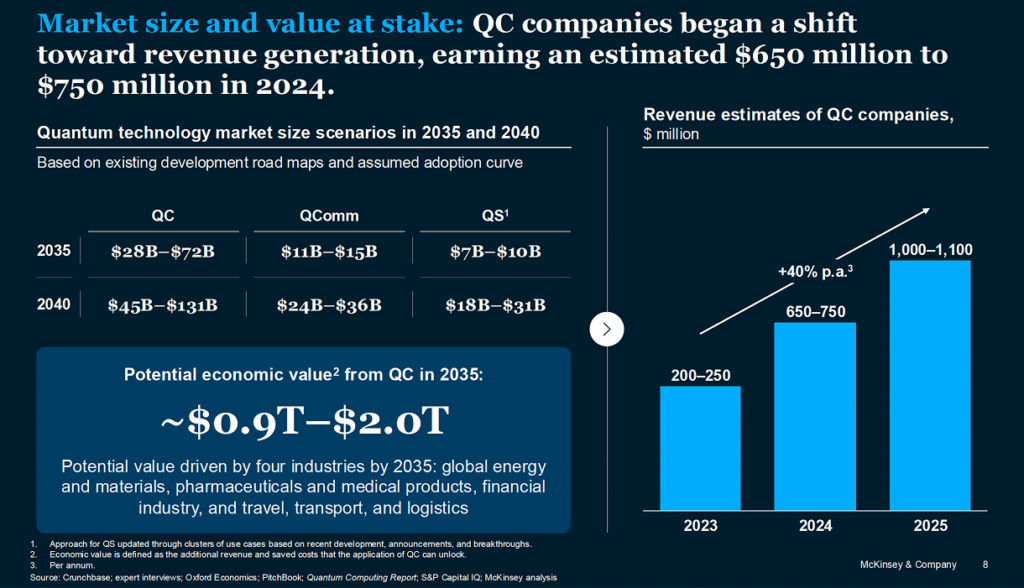
Long-term projections highlight the possible scale of the opportunity. The “Quantum Technology Monitor 2025” study by McKinsey estimates that quantum computing could unlock $900bn to $2tn in economic value by 2035, with the most significant impact expected in sectors such as pharmaceuticals, energy, finance, and logistics.
Public markets have already begun to price in part of this future potential. Many quantum computing stocks reached peak valuations in October 2025, driven by investor enthusiasm around advanced computing technologies and a series of research announcements from major technology groups. Since then, the sector has cooled significantly, with several prominent quantum stocks falling more than 50 per cent from their highs as investors reassessed the timeline for commercialization.
The following analysis examines the leading quantum computing stocks, the technologies they are developing, and the opportunities and risks investors should consider when evaluating this emerging sector.
4 Things to Know About Quantum Computing Stocks
- Several types of companies are involved: The sector includes pure-play quantum developers such as IonQ, D-Wave, Rigetti, and Quantum Computing Inc., as well as large technology firms like IBM, Microsoft, and Alphabet.
- Multiple technologies are competing: Trapped-ion, superconducting, photonic, and annealing systems are all being developed, and no dominant architecture has emerged yet.
- Hybrid computing is the current focus: Most practical applications today combine classical high-performance computing with quantum processors.
- Commercial adoption will take time: Early applications may appear in areas like drug discovery and optimization, but broader deployment depends on advances in qubit stability, error correction, and scalability.

Types of Quantum Stocks
There are three main types of companies in the quantum computing industry, each operating at a different layer of the technology stack. Most firms are still developing early systems, which means the sector remains driven by research, prototypes, and pilot programs rather than large-scale commercial deployments.
Quantum Hardware Developers
The first group consists of quantum hardware developers building the physical machines that perform quantum calculations. These companies design processors based on different qubit technologies. Publicly traded examples include IonQ, Rigetti Computing, D-Wave Quantum, and Quantum Computing Inc., while major technology companies such as IBM and Alphabet also develop their own quantum processors.
Some systems rely on trapped-ion architectures, where individual atoms are controlled with lasers to produce stable qubits. Others use superconducting circuits, which allow faster gate operations and benefit from semiconductor manufacturing techniques. A third approach focuses on photonic processors, which encode quantum information using light and may eventually enable compact systems with lower signal noise.
While these designs show promise, most machines remain in the prototype or early commercial stage, typically accessed through research collaborations or cloud platforms.
Quantum Software and Algorithms
The second group consists of quantum software developers. These companies build programming frameworks, quantum algorithms, and early applications designed to run on different types of quantum hardware.
Much of this software is delivered through cloud-based quantum platforms such as Azure Quantum, IBM Quantum, or AWS Braket, allowing researchers and businesses to experiment with quantum processors remotely. Today most applications remain experimental or proof-of-concept rather than production-level systems.
Over time, many analysts expect a large portion of the industry’s economic value to emerge from software and algorithms that solve specific industrial problems.
Large Technology Companies
The third group includes large technology companies such as IBM, Microsoft, Alphabet, Nvidia, Amazon, and Intel. These firms integrate quantum computing research into broader innovation programs that also include artificial intelligence, advanced semiconductors, and cloud infrastructure.
For these companies, quantum computing remains a long-term strategic investment. Their resources allow them to fund large research programs, develop experimental processors, and provide cloud access to early quantum systems.
Examples of Companies by Category
Category | Public Companies | Private Companies |
|---|---|---|
Quantum hardware developers | IonQ, Rigetti Computing, D-Wave Quantum, Quantum Computing Inc. | Quantinuum, PsiQuantum, QuEra Computing, Pasqal, Xanadu, Atom Computing |
Quantum software developers | IonQ, Quantum Computing Inc. | Zapata AI, QC Ware, Classiq, Q-CTRL, Multiverse Computing, 1QBit |
Large technology companies | IBM, Microsoft, Alphabet, Nvidia, Amazon, Intel | — |
Because the technology is still evolving, quantum computing stocks often react strongly to scientific announcements. Progress in areas such as error correction, modular scaling, or demonstrations of quantum advantage can quickly influence investor sentiment, even though these breakthroughs represent early steps toward commercial systems.
Industry leaders increasingly expect the first practical applications to appear in targeted high-value fields, including drug discovery, cybersecurity research, advanced materials design, and industrial optimization. These early use cases will likely serve as testing grounds before broader adoption of quantum computing becomes possible.
Categories and Strategic Profiles
1. IonQ (NYSE:IONQ)
IonQ builds quantum computers using trapped-ion technology, where individual atoms are held in place by lasers and used as qubits. These qubits have high two-qubit gate fidelity, which means they can perform accurate operations more often. This is an important step toward creating a fault-tolerant quantum computer that can run for long periods without errors.
The company’s systems are available through Azure Quantum and other cloud-based quantum computing platforms. This allows researchers and businesses to use IonQ’s machines for tasks such as AI applications, remote sensing, and testing new quantum algorithms without having to own the hardware themselves.
IonQ strengthened its capabilities by acquiring Oxford Ionics, gaining expertise in photonic computing engines and integrated photonics. These technologies could help reduce errors and make it easier to scale quantum systems by connecting multiple modules together.
Financial snapshot:
- Market cap: $13.2 billion
- Estimated revenue 2026: $236 million
- Projected revenue 2027: $355 million
- Price-to-sales (2026): 55.9x
IonQ is seen as a quantum pioneer with a long-term vision. However, heavy investment in research and development means profitability is still years away.

2. D-Wave Quantum (NASDAQ:QBTS)
D-Wave builds annealing quantum systems, which are designed for quantum optimization tasks. These include vehicle routing, enterprise-scale factory scheduling, and portfolio management. Annealing systems are not universal quantum computers, but they can be very effective for specific types of problems where many possible solutions must be tested quickly.
Its current platform includes the Advantage 2 system and the Leap quantum cloud service. These work with quantum hybrid solvers, allowing businesses to combine classical and quantum processing for better results in certain optimization problems.
Unlike many quantum companies that remain focused on research, D-Wave already has paying customers. It has seen adoption in areas such as cyber security, logistics, and high performance computing. While the technology is still early stage, it is one of the few quantum systems being used in real-world commercial environments today.
Financial snapshot:
- Market cap: $7.0 billion
- Estimated revenue 2026: $44.0 million
- Projected revenue 20267 $85.6 million
- Price-to-sales (2026): 159.0x
D-Wave’s strong cash reserves give it room to keep improving its systems and expanding its customer base. Its focus on practical use cases today sets it apart from peers that are still entirely in development mode.

3. Rigetti Computing (NASDAQ:RGTI)
Rigetti develops superconducting quantum hardware using a modular scaling approach, which aims to link smaller quantum processors together to build more powerful systems over time. The company also operates its own foundry services for chip fabrication. This vertical integration allows Rigetti to work on qubit design, quantum integrated circuits, and supporting software tools all under one roof.
Rigetti works with partners in both the public and private sectors. One example is its collaboration with the Air Force Office of Scientific Research to explore AI applications and quantum research for defense-related problems. The company’s strategy is to align hardware advances with easy-to-use quantum emulators and cloud-based delivery, so developers can test and build applications even before large-scale hardware is ready.
Financial snapshot:
- Market cap: $5.6 billion
- Estimated revenue 2026: $22.0 million
- Projected revenue 2027: $44.6 million
- Price-to-sales (2026): ~125.6x
Rigetti’s potential lies in combining hardware innovation with developer-friendly software access. Its challenge will be scaling technology fast enough to keep pace with other competitors.

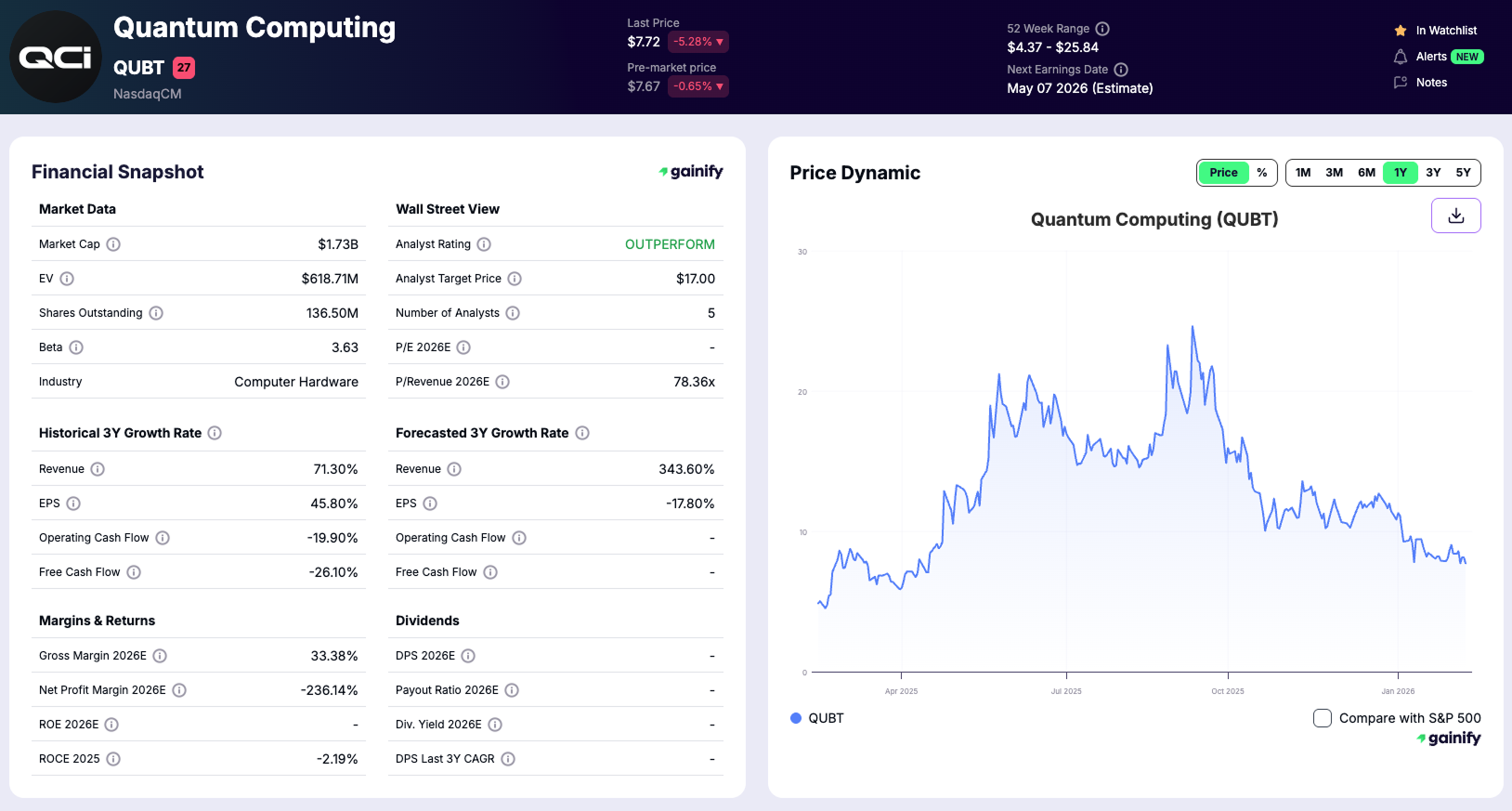
4. Quantum Computing (NASDAQ:QUBT)
Quantum Computing Inc. focuses on integrated photonics, thin film lithium niobate components, and photonic computing engines that can be used for quantum communication and secure networking. These technologies aim to send and process quantum information using light, which can be more resistant to certain types of interference.
The company targets specialized markets such as cyber security and satellite-based remote sensing, where secure and efficient data transfer is critical. Its research includes work on entangled photon sources and photonic error correction, both of which could play a role in building future quantum communication networks.
Financial snapshot:
- Market cap: $1.7 billion
- Estimated revenue 2026: $23.4 million
- Projected revenue 2027: $34.6 million
- Price-to-sales (2026): 72x
While QUBT’s revenue is currently very small, its focus on photonics gives it a niche position in the broader quantum market. If quantum communication infrastructure grows in importance, the company’s early research could become a strategic advantage.
5. Tech Giants with Quantum Footprint: Microsoft, IBM, Alphabet
Through Azure Quantum, Microsoft is developing a path toward scalable, fault-tolerant quantum computers using topological qubits built from topological superconductors, sometimes referred to internally as “topoconductors.” The Majorana 1 chip project is part of its broader Quantum System Two initiative, which focuses on improving two-qubit gate fidelity and creating designs that can integrate smoothly into enterprise-scale cloud services. Microsoft CEO Satya Nadella has described this as a “next-generation computer” effort intended for cloud-first adoption. Microsoft’s approach remains research-focused, with real-world deployment still in the early stages.
International Business Machines (NYSE:IBM):
International Business Machines (IBM) continues to advance its superconducting qubit roadmap, aiming for larger systems with better error correction and modular scaling. Its Quantum System Two architecture is designed to link multiple quantum processors into a more powerful, unified system. IBM’s research supports industries such as drug discovery, AI model training, and high performance computing. These systems are primarily used for experimentation and early-stage pilots rather than production-scale operations.
Google, through its quantum division, is developing Sycamore processors to explore quantum advantage in areas such as chemistry simulations and optimization problems. The company has also demonstrated quantum processors integrated into advanced computing setups that combine AI and quantum workloads. Some of this work is compatible with CUDA Quantum programming environments and tested on DGX Quantum platforms using the Grace Hopper Superchip for co-processing. This research remains in the prototyping phase and is not yet commercially available.
What Is the “Mythical” Quantum Computer?
The “mythical” quantum computer refers to the popular idea of a universal machine capable of solving any computational problem dramatically faster than classical computers. This concept is often associated with a fault-tolerant quantum computer that can run complex algorithms reliably at large scale. In reality, such a system does not exist yet.
Today’s quantum technology consists of multiple competing hardware approaches rather than one universal design. Trapped-ion processors emphasize qubit stability, superconducting circuits focus on faster operations and scalability, photonic systems process information using light, and annealing machines specialize in optimization problems. These architectures represent different technical paths, each suited to particular types of calculations.
Current quantum computers are therefore specialized experimental systems, not general-purpose replacements for classical machines. Some platforms are useful for optimization problems, others for chemistry simulations or secure communications. No existing system can efficiently handle the full range of computational tasks performed by classical computers.
The main obstacle is error correction. Quantum bits are extremely sensitive to noise and interference, which introduces errors during calculations. Building a fault-tolerant quantum computer requires sophisticated error-correction methods and a much larger number of stable qubits than today’s machines can support.
As a result, the industry is focusing on incremental progress. Researchers are improving qubit fidelity, connecting smaller processors into modular systems, and combining quantum hardware with classical high-performance computing. The goal is to identify specific workloads where quantum systems can demonstrate a clear advantage before attempting large-scale universal machines.
In practical terms, the “mythical” quantum computer remains a long-term objective. Current quantum systems function as specialized tools that complement classical computing rather than replacing it.
Myth vs. Reality
Myth | Reality |
|---|---|
Quantum computers will replace classical computers completely | Quantum systems are expected to work alongside classical computers, accelerating specific calculations |
A universal quantum computer already exists in secret labs | Existing machines are experimental systems with limited capabilities |
Quantum computing will solve every problem instantly | Only certain problems benefit from quantum algorithms |
Universal fault-tolerant machines are only a few years away | Achieving this may take decades and depends on advances in error correction and scalability |
Investor Implications at a Glance
Quantum computing stocks offer exposure to a potentially transformative technology, but they also come with high uncertainty and long development timelines. Most companies in the sector are still focused on research, prototype systems, and early pilot programs rather than large-scale commercial deployments. As a result, investors should evaluate both technological progress and financial sustainability when analyzing these companies.
Pure-play quantum firms typically provide the most direct exposure to the technology but often operate with small revenue bases and significant research spending. At the same time, large technology companies invest heavily in quantum research while generating most of their revenue from cloud computing, software, and artificial intelligence. This creates different risk profiles across the sector.
The table below highlights some of the main strengths and considerations for several of the most closely followed quantum computing companies.
Company | Strengths | Considerations |
IonQ | Advanced trapped-ion systems, integrated photonics expertise, strong cloud access through Azure Quantum and other platforms | Heavy R&D spending with profitability still years away |
D-Wave | Proven commercial use of annealing quantum systems, effective quantum hybrid solvers for optimization | Focused on a narrow niche rather than universal quantum hardware |
Rigetti | Modular scaling design, in-house foundry for custom chip fabrication, government and defense partnerships | Complex execution challenges and slower-than-expected revenue growth |
QUBT | Photonic computing engines and quantum communication research with long-term potential | Very small revenue base and highly speculative path to adoption |
Microsoft & other tech giants | Large-cap resources, AI and cloud integration, Azure Quantum ecosystem | Quantum revenue will remain a small part of the business in the near future |
Conclusion
Quantum computing stocks sit at the intersection of advanced research and long-term industrial potential. Companies such as IonQ, D-Wave, Rigetti, and Quantum Computing Inc. are developing different hardware architectures, while large technology firms including IBM, Microsoft, and Alphabet continue investing heavily in quantum infrastructure and cloud access.
The industry is still in an early phase, with most systems used in research environments or limited commercial pilots. Competing technologies, high research spending, and uncertain timelines mean the sector remains volatile, as seen after quantum stocks peaked in late 2025 before correcting sharply.
For investors, the key question is which companies can translate scientific breakthroughs into scalable systems and practical applications. Progress in error correction, qubit stability, and industrial use cases will determine whether today’s experimental machines evolve into commercially valuable computing platforms.
Frequently Asked Questions About Quantum Computing Stocks
What are quantum computing stocks?
Quantum computing stocks are companies developing the hardware, software, and platforms required to build and operate quantum computers. These companies represent the computing segment of the broader quantum technology ecosystem, which also includes quantum communication and quantum sensing. Quantum computing uses the principles of quantum mechanics to process information and potentially solve certain complex problems more efficiently than classical computers.
Why are quantum computers considered powerful?
Quantum computers rely on three fundamental properties of quantum mechanics: superposition, entanglement, and interference. These allow quantum bits, or qubits, to exist in multiple states simultaneously and interact in ways that classical bits cannot. Because of this, quantum computers can explore many possible outcomes at once, making them particularly useful for complex calculations such as simulations, optimization, and machine learning tasks.
What types of problems could quantum computers solve?
Quantum computers are expected to be most useful for problems that require complex simulations or advanced mathematical optimization. Examples include modeling chemical reactions for drug discovery, designing new materials, optimizing logistics and supply chains, and improving financial modeling. Quantum computing could also affect cybersecurity by enabling new encryption methods while potentially challenging existing encryption systems.
How big could the quantum computing industry become?
The industry is still small today but growing quickly. McKinsey & Company estimates that quantum computing companies generated roughly $650 million to $750 million in revenue in 2024, with revenues expected to exceed $1 billion by 2025 as commercial pilot programs expand. Long-term projections suggest the market could reach $28 billion to $72 billion by 2035 depending on how quickly the technology matures.
What economic impact could quantum computing create?
Beyond the direct market for quantum hardware and software, the broader economic impact could be significantly larger. Estimates suggest quantum computing applications could unlock between $900 billion and $2 trillion in economic value by 2035, particularly in industries such as pharmaceuticals, energy, financial services, and transportation.
How much investment is flowing into quantum technology?
Investment in quantum start-ups has increased significantly in recent years. Funding reached approximately $2 billion in 2024, up from about $1.3 billion in 2023. More than 80 percent of this investment targets quantum computing companies, highlighting strong investor interest in computing platforms rather than other quantum technologies.
Which countries are leading quantum technology development?
Quantum innovation is distributed across several regions. The United States and Japan lead in the number of patents granted across quantum technologies, while China leads in scientific research publications. Together, U.S. and Chinese companies account for more than half of global patent applications related to quantum technologies.
What is the biggest technical challenge in quantum computing?
The biggest technical challenge is controlling errors in qubits. Quantum systems are extremely sensitive to noise and environmental interference, which can disrupt calculations. Researchers are working on several approaches to address this issue, including error suppression, error mitigation, and quantum error correction. Achieving reliable error correction is considered a critical step toward building large-scale, fault-tolerant quantum computers.
Why are quantum computing stocks volatile?
Quantum computing stocks often move sharply because the industry is still driven by scientific progress rather than stable revenue. Announcements about breakthroughs in qubit stability, processor performance, or error correction can quickly change investor expectations about the timeline for commercial quantum computing.
Are quantum computing stocks long-term investments?
Quantum computing stocks are generally considered long-term and high-risk investments. Many companies in the sector are still in the research and development stage, with limited revenue today. Their long-term value will depend on whether quantum technology can achieve reliable, scalable systems capable of solving real industrial problems.