


Not all company growth creates real value.
Some businesses expand rapidly but generate weak returns on the capital they use. Others grow more slowly yet consistently turn invested capital into profit.
One metric helps explain that difference: Return on Capital Employed (ROCE).
ROCE measures how efficiently a company uses its capital to generate operating profit. In simple terms, it shows whether management is turning debt and equity into meaningful returns, or just growing for the sake of growth. For investors, ROCE is one of the clearest ways to understand business quality beyond revenue headlines.
This guide explains Return on Capital Employed (ROCE) in plain language. You’ll learn what ROCE is, how to calculate it, what a good ROCE looks like, and how investors use it to compare companies across industries and market cycles.
If you want a simple way to identify businesses that consistently create value, ROCE is a good place to start.
Return on Capital Employed in 30 Seconds
- What it is: Return on Capital Employed (ROCE) measures how efficiently a company turns long-term capital into operating profit.
- Why it matters: It shows whether growth is creating value or just consuming capital.
- How it’s calculated: ROCE = EBIT ÷ Capital Employed.
- How to use it: Compare ROCE across companies in the same industry and over time.
- What to look for: Consistently high ROCE, ideally above the company’s cost of capital.
What Is Return on Capital Employed (ROCE)?
Return on Capital Employed (ROCE) is a financial metric that measures how efficiently a company uses its long-term capital to generate operating profit.
In simple terms, ROCE answers one key question: For every dollar of capital invested in the business, how much operating profit does the company produce?
ROCE includes both equity and debt, making it especially useful for evaluating companies that rely heavily on physical assets, infrastructure, or long-term investment. Unlike profit margins or revenue growth, ROCE focuses on capital efficiency.
A higher ROCE means the company is generating more profit from the capital it employs. A lower ROCE suggests capital is tied up without producing strong returns.
Because it captures how effectively management deploys resources, ROCE is widely used to:
- Compare companies within the same industry
- Evaluate capital-intensive businesses
- Assess long-term business quality
ROCE Formula
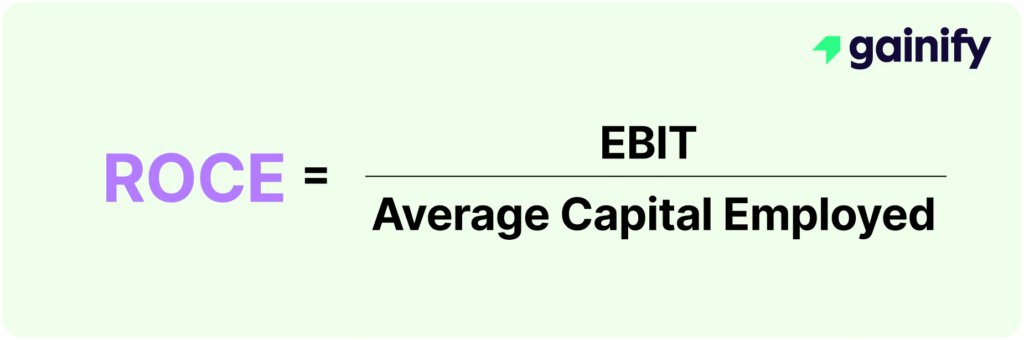
The most commonly used formula for Return on Capital Employed (ROCE) is: ROCE = EBIT ÷ Average Capital Employed
Formula for Return on Capital Employed
Where:
EBIT (Earnings Before Interest and Taxes)
EBIT represents a company’s core operating profit. It’s the profit a company generates from its operations before accounting for interest payments and income taxes. EBIT (operating profit) excludes non-operating income/expenses and provides a cleaner view of the firm’s ability to generate profit from its actual business activities.
Average Capital Employed
Capital employed reflects the long-term capital invested in the business, including both equity and long-term debt.
To improve accuracy, many investors use the average capital employed over a period, calculated as:
Average Capital Employed = (Beginning Capital Employed + Ending Capital Employed) ÷ 2
There are two common ways to determine capital employed before averaging:
1. Total Assets − Current Liabilities
Captures capital tied up in long-term operations and excludes short-term obligations.
2. Equity + Long-Term Debt
Focuses on permanent capital provided by shareholders and lenders.
Both methods aim to measure the capital management must deploy to generate profits.
Simple Example
If a company reports:
- EBIT of $200 million, and
- Average capital employed of $1 billion,
Then: ROCE = 200 ÷ 1,000 = 20%
This means the business generates 20 cents of operating profit for every dollar of capital employed.
EBIT (Earnings Before Interest and Taxes):
How to Interpret ROCE
ROCE = How Efficiently a Company Turns Capital Into Profit
Unlike metrics that only focus on equity (like ROE) or total returns (like ROIC), Return on Capital Employed zeroes in on how well a company is using its invested long-term capital to generate operating profit.
A high ROCE indicates:
- Strong operational efficiency.
- Effective use of both debt and equity capital.
- A potential for value creation without necessarily growing asset base or leverage.
A low ROCE may suggest:
- Inefficiency in operations or capital allocation.
- Underutilized assets or poor investment decisions.
Investor Insight: ROCE helps investors understand how well management is using the capital at its disposal. It’s especially relevant when comparing capital-intensive industries like manufacturing or utilities versus asset-light businesses like software.
What Is a Good ROCE?
A “good” Return on Capital Employed (ROCE) depends on the type of business and how much capital it requires to operate. There is no single universal benchmark, but investors use clear guidelines to assess whether a company is using capital effectively.
As a general STARTING POINT:
- ROCE above 15% is often considered strong
- ROCE between 10% and 15% is acceptable in many industries
- ROCE below 10% may indicate weak capital efficiency
These thresholds are not absolute. What matters more is context.
ROCE and Value Creation
The most important comparison is between ROCE and the company’s cost of capital, commonly measured by the weighted average cost of capital (WACC).
- When ROCE exceeds WACC, the company is creating value
- When ROCE is close to WACC, value creation is limited
- When ROCE is below WACC, capital may be destroying value
A company does not need an exceptionally high ROCE to be attractive, but it does need to earn more on its capital than it costs to fund it.
Industry Context Matters
ROCE varies significantly by industry because capital requirements differ.
- Asset-light businesses, such as software or consulting firms, typically report higher ROCE due to lower capital needs
- Capital-intensive industries, such as utilities, manufacturing, or telecom, usually operate with lower ROCE because large asset bases are required
For this reason, ROCE should almost always be compared against industry peers, not across unrelated sectors.
ROCE vs. ROIC vs. ROE: What’s the Difference?
While ROCE is powerful on its own, it’s often compared to two other popular metrics: ROIC and ROE. Each serves a specific purpose and provides different insights depending on the context.
Return on Invested Capital (ROIC)
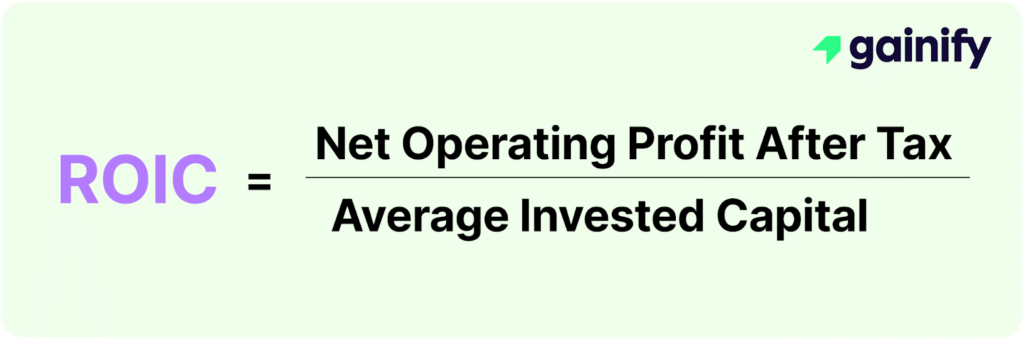
Formula for Return on Invested Capital:
ROIC = NOPAT ÷ Average Invested Capital
Where:
NOPAT (Net Operating Profit After Tax): This is the profit from core business operations after a specific tax rate is applied, excluding the impact of interest expenses. It gives a cleaner picture of operational efficiency by removing distortions caused by capital structure, but it is not a cash-flow metric.
Invested Capital: Represents the capital actually invested in operations. Calculated as: Invested Capital = Debt + Equity – Non-operating Assets. This formula excludes idle or non-operational assets (like excess cash or passive investments), focusing only on the capital used to run the business. This information is taken from financial statements.
Return on Equity (ROE)
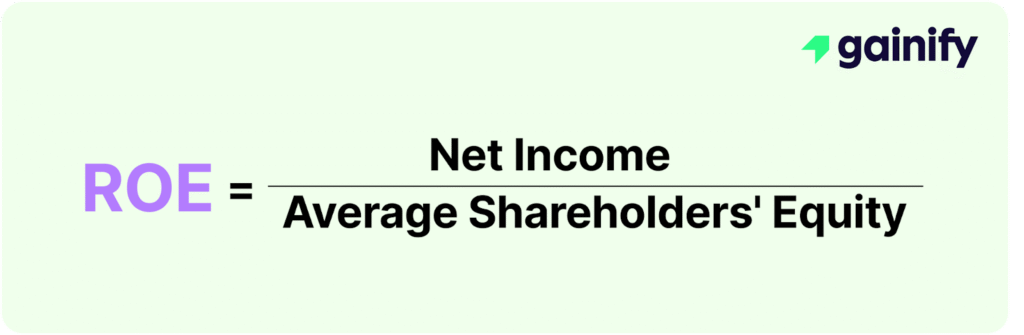
Formula for Return on Equity:
ROE = Net Income ÷ Average Shareholders’ Equity
ROE focuses exclusively on the return generated on the shareholders’ equity portion of a company’s capital. It reflects the company’s ability to generate net income (after interest and tax) from the capital that equity holders have invested. While useful, ROE does not account for the company’s debt burden or how other forms of capital contribute to profitability. It’s often elevated by higher leverage, which can artificially boost performance. Therefore, it is crucial to interpret ROE alongside other return metrics, particularly when evaluating capital-intensive or highly leveraged firms.
Comparison Table
Feature | ROCE | ROIC | ROE |
Profit Measure | EBIT (Pre-Tax) | NOPAT After-Tax (Net Operating Profit After Tax) | Net Income (After Interest & Tax) |
Capital Base | Total Assets – Current Liabilities | Invested Capital (Operating Assets) | Shareholders’ Equity |
Capital Type | Debt + Equity | Operating Debt + Equity | Shareholder Equity Only |
Tax Adjustment | No | Yes | Yes |
Focus | Operational efficiency | Value creation vs Weighted Average Cost of Capital | Shareholder returns |
How ROCE Informs Investor Decisions
1. Screening for High-Quality Businesses
Investors often screen for companies with high and consistent ROCE figures, as these companies demonstrate strong operational efficiency and sound management. A company with a robust ROCE that exceeds its industry average suggests a durable competitive advantage and effective deployment of resources.
2. Assessing Capital Allocation Decisions
ROCE helps both investors and corporate decision-makers assess whether capital is being used wisely. If ROCE consistently falls below the company’s weighted average cost of capital (WACC), it signals that the business may be destroying value, suggesting the need to reassess capital expenditures or strategic investments.
3. Sector Benchmarking and Strategic Comparison
Since capital requirements vary across sectors, ROCE is particularly useful for benchmarking companies within capital-intensive industries like energy, telecom, or manufacturing. Comparing ROCE across peers offers insights into which firms are better at converting capital into profit, independent of size or market share.
Final Thoughts
Return on Capital Employed (ROCE) is more than just a financial ratio — it’s a critical lens through which investors and analysts assess how efficiently a company converts capital into profit. In a landscape where capital allocation defines long-term competitiveness, ROCE offers a holistic, debt-inclusive measure of performance that cuts through accounting noise.
When paired with complementary metrics like ROIC and ROE, ROCE allows for a layered understanding of profitability:
- ROCE emphasizes operational efficiency across all capital.
- ROIC zooms in on returns from core invested assets.
- ROE focuses on equity-driven returns for shareholders.
Together, they form a comprehensive toolkit for comparing companies across sectors, evaluating capital allocation strategies, and identifying high-quality, high-return businesses. For investors seeking long-term value and management discipline, ROCE isn’t just useful — it’s essential.